The Name and Its Record
In the published works the mountain is known by a single name, Gundabad, usually joined to the English title Mount. It first appears in The Hobbit, where the narrator gives it in passing as the northern height that housed the goblins' chief seat, the place from which their great muster set out. The name is not introduced as the goblins' own word. It is simply the name the narrative uses, as it uses Mirkwood or the Grey Mountains, without saying who first spoke it. The appendices to The Lord of the Rings use the same form in a very different setting. In the chronicle of Durin's Folk, Gundabad marks the northern limit of the Dwarves' campaign of vengeance against the Orc-holds of the Misty Mountains. The name therefore stays the same whether the account follows the goblins or their enemies.1
What the published texts do not supply is just as telling. No translation of Gundabad is given, and no parallel name in Elvish, in the Common Speech or in the tongue of the Orcs is recorded beside it. This is unlike several neighbouring peaks of the same range. When the Company approaches Moria, Gimli names three mountains in turn, pairing a Dwarvish name with an Elvish one and a Westron one, so that a single height carries three names from three peoples. Gundabad receives no such treatment. It stands in the narrative as a bare proper name with no gloss, and its form suggests nothing Elvish. Anyone reading only the books Tolkien saw into print can say where the name belongs, at the northern end of the mountains, but not what it means or in which language it arose. That question is answered, if at all, only in material outside the published canon, and it is treated in its own place.2
Situation and Character
Gundabad is a single great height in the far north of the Misty Mountains, standing where that long range comes to its end. It is not a region with borders or a realm with frontiers. The texts treat it as one mountain, marked out only by its size and its northern position. It lies beyond the High Pass and the goblin tunnels beneath it, where Bilbo and the Dwarves were taken, and far to the north of Moria at the other end of the range. Nothing in the published narrative describes its outline, its slopes or its summit. It is known through what it held and through the paths that led out from it, not through any account of its appearance.1
In The Hobbit its place in the landscape shows most clearly in movement. After the death of the Great Goblin, word travelled through the mountains, and the goblins drew together from their scattered holds at the northern mountain that served as their capital. From there the assembled host came against the Lonely Mountain out of the north. Gundabad thus lies at the hidden centre of a network of passages and dwellings that ran through the range. It was also near enough to the lands east of the mountains for an army to reach Erebor from it. The narrator places it only in relation to other places: north of the goblin holds already met in the story, and a point of departure for a march that ended far to the east.2
The chronicle of Durin's Folk sets the mountain within a chain of Orc-holds that ran along the Misty Mountains, with Gundabad at the northern end and the country around the Gladden, where that river comes down to the Great River, at the southern. The line of the Dwarves' campaign follows the range itself, so Gundabad stands as the northern anchor of a whole occupied mountain system rather than as a lone fastness. This is what sets it apart among the heights of the range. Other peaks are remembered for passes, gates or delvings, but Gundabad marks the northern end of the mountains and was also the seat from which their goblin dwellers took direction.3
History
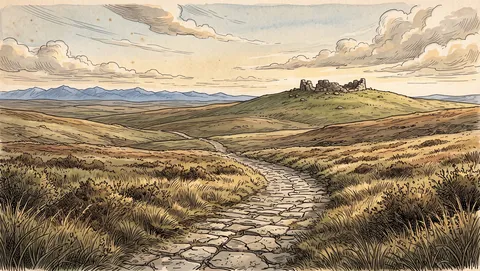
The works published in Tolkien's lifetime say nothing of Gundabad before the later Third Age. They record neither when the mountain was first settled nor when or how it passed into the hands of the Orcs. The tradition that gives it an older and Dwarvish beginning comes only from later writings and is treated in its own place. What the chronicle does set down is the general darkening of the range. Around the year 2480 of the Third Age the Orcs began to build hidden strongholds throughout the Misty Mountains, meaning to close the passes into Eriador, while Sauron started to fill Moria with his servants. Gundabad is not named in that entry. By the time it enters recorded history, however, it already stands at the northern end of just such a chain of occupied holds.1
The mountain first appears in the annals through the feud between Durin's Folk and the Orcs of the range. In 2790 Thrór, the exiled King under the Mountain, entered Moria and was killed there by the Orc-chieftain Azog, who mutilated his body and cast it out in contempt. His son Thráin took this as an injury to the whole race. He sent word to all the houses of the Dwarves, and after three years of gathering their strength they opened the war in 2793. For six years the Dwarves hunted their enemy along the length of the mountains. Much of the fighting took place in tunnels and deep halls, and they plundered one Orc-hold after another along the line that the chronicle draws from Gundabad in the north to the Gladden in the south.2
The campaign came to a head in 2799 at the eastern gate of Moria, in the vale of Azanulbizar, where the Orcs driven down the range made their last stand. The Dwarves won at a very heavy cost. Dáin, the son of Náin, killed Azog before the gate, but so many of the Dwarves fell that none of the kindreds had the strength or the will to reclaim Moria. The victors went their separate ways, and the Orc-holds of the mountains were left weakened but not wiped out. The chronicle does not say whether Gundabad itself was taken in the war or how long it lay broken afterwards. It says only that the mountain marked the northern limit of the vengeance.3
Within a century and a half the goblins of the North had recovered, and Gundabad was once more their chief seat. In 2941 Gandalf killed the Great Goblin in the tunnels below the High Pass, and the goblins of the range resolved to take revenge. The host that gathered at Gundabad was commanded by Bolg of the North, a son of the same Azog who had fallen at Azanulbizar, so the old feud with Durin's line carried on into a new generation. Wolves marched with the goblins as allies. Their army came upon the Dwarves, Elves and Men at Erebor and brought about the Battle of Five Armies, which the chronicle places in the same year.4
The battle went badly for the goblins. Beorn killed Bolg in the final struggle, and in the rout that followed most of the goblin fighters of the North died, whether in the field, in flight, or in the river and the forest they tried to escape through. The narrator says that the mountains then enjoyed peace for many years, which suggests that the power based at Gundabad was broken for a generation or more. After this the published record stops following the mountain. The War of the Ring as told in The Lord of the Rings does not return to it, and nothing is recorded of its fate at the end of the Third Age or in the Fourth. Whether Orcs still held it, or anyone else later reclaimed it, is not told.5
- 1The Lord of the Rings, Appendix B, The Tale of Years
- 2The Lord of the Rings, Appendix A, III, Durin's Folk; The Lord of the Rings, Appendix B, The Tale of Years
- 3The Lord of the Rings, Appendix A, III, Durin's Folk
- 4The Hobbit, Chapter 17, The Clouds Burst; The Lord of the Rings, Appendix B, The Tale of Years
- 5The Hobbit, Chapter 18, The Return Journey
People and Rule
Every inhabitant of Gundabad named in the works Tolkien published is a goblin or Orc. The Hobbit calls the mountain their capital, which places it above the other goblin dwellings of the range, but the narrative never explains what that primacy involved. The holds of the Misty Mountains each had their own masters. The Great Goblin ruled the caverns under the High Pass, and in the chronicle of Durin's Folk Azog is lord of Moria. Neither is said to answer to Gundabad. The published texts therefore record a northern seat without a recorded court, and nothing is said of how the goblins there were organized, what they made or how they lived day to day.1
No succession of rulers is recorded for the mountain. The only leader connected with it by name is Bolg of the North, and the text presents him as the commander of the gathered host rather than as the lord of the place. It does not say whether he held any lasting authority there. His following at the battle included a guard of unusually large goblins, the only detail the narrative gives about the fighting strength of the North. Once Bolg has died, the record names no successor.2
The goblins' dealings with the peoples around them were almost entirely hostile. The narrator of The Hobbit notes that they nursed a special hatred of Thorin's people on account of an earlier war, and the chronicle of Durin's Folk shows how old and bitter that enmity was. Their one recorded partnership was with the wolves, who at times joined them in raids on the lands below the mountains, and the northern host set out with bats swarming above it. The Eagles of the range, Beorn and the Elves and Men of the lands to the east appear in the narrative only as their enemies.3
- 1The Hobbit, Chapter 17, The Clouds Burst; The Hobbit, Chapter 4, Over Hill and Under Hill; The Lord of the Rings, Appendix A, III, Durin's Folk
- 2The Hobbit, Chapter 17, The Clouds Burst; The Hobbit, Chapter 18, The Return Journey
- 3The Hobbit, Chapter 4, Over Hill and Under Hill; The Hobbit, Chapter 6, Out of the Frying-Pan into the Fire; The Hobbit, Chapter 17, The Clouds Burst
Role in the Story
Gundabad is a place the story never visits. No character in The Hobbit travels there, no scene is set within it, and the narrator gives it no description beyond its northern position and its rank among the goblin dwellings. It enters the tale only at the moment its host is already on the march, so the reader learns of the mountain and of the danger it sends out at the same time. This late and indirect introduction gives Gundabad its narrative weight. The tunnels under the High Pass had seemed to be the goblin world in full, and the naming of a distant capital shows that Bilbo's earlier ordeal touched only one corner of a much larger realm beneath the mountains.1
Within the plot, the army from the North arrives at the point where the story's central quarrel has become deadlocked. Thorin, besieged in the Lonely Mountain, refuses to share the treasure, while the Men of the Lake and the Elves of the forest press their claims, and Dáin's Dwarves have come to his aid. Gandalf's warning of the approaching goblins turns these rival parties into allies almost at once. The mountain thus acts as the source of an outside threat that ends a conflict the characters could not settle among themselves. It also shifts the book's concern away from the possession of gold and toward a common defence.2
The Lord of the Rings leaves Gundabad out of its main narrative entirely, and the Fellowship's road never comes near it. The mountain returns only in the appendices, in a Dwarvish chronicle rather than a hobbit's tale, where it serves as one end of a line of vengeance. Read together, the two books present it from opposite sides without ever showing it directly: once as the home from which the enemy sets out, once as the farthest point the Dwarves reached in pursuit of that enemy.3
Drafts and Late Writings
The older, Dwarvish meaning of Gundabad does not come from any draft of The Hobbit or The Lord of the Rings. It appears in one of Tolkien's latest linguistic and historical essays, Of Dwarves and Men, which Christopher Tolkien published in The Peoples of Middle-earth. There, in a note on the origins of the Dwarvish kindreds, the mountain is named as the place where the forefather of the Longbeards awoke. This single statement explains why the Dwarves held Gundabad in reverence. The same note settles the linguistic question left open in the published books: the name is said to be Khuzdul in origin. The text gives no translation of it, however, so what it means remains unknown even here.1
The essay also gives the mountain a role among the Dwarves as a whole. In the early ages it served as a meeting place where the scattered kindreds sent representatives to confer, so the mountain was more than a shrine of Durin's line. Seen in this light, the later Orc occupation is a desecration and not merely a strategic loss, and the essay names it as one of the main reasons for the Dwarves' bitter hostility toward the Orcs. None of this is contradicted by the goblin capital of The Hobbit. It adds a prior history that the earlier book neither knew nor needed. Because Tolkien never worked the idea into a revised text, the Dwarvish Gundabad remains a late elaboration, consistent with the published record but not part of it.2
Adaptations
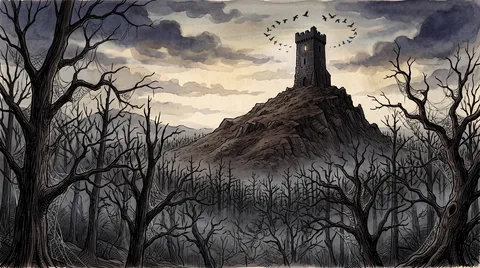
Gundabad plays its largest screen role in Peter Jackson's Hobbit trilogy, above all in its final part, The Battle of the Five Armies. The films change the mountain's function in the war. In the novel the northern host sets out from Gundabad under Bolg and forms the whole goblin army at Erebor. In Jackson's version the main Orc force is led by Azog, played by Manu Bennett, who survived Azanulbizar in the films and was not killed there, and it comes out of Dol Guldur. Gundabad supplies a second army under Bolg, which reaches the battle later as a reserve. The films also place the mountain in a larger pattern of Sauron's return, linking the northern stronghold to the Necromancer's plans, a connection the novel does not draw.1
The trilogy also does what neither book does and takes characters to the mountain itself. Legolas, played by Orlando Bloom, and Tauriel, a character invented for the films and played by Evangeline Lilly, ride north to scout Gundabad and discover the second army gathering there. They then carry word of it back to the fighting at Erebor. The films treat the place as an old Dwarvish fortress later taken by the Orcs. This comes closer to the reverence described in Tolkien's late essay than to anything in The Hobbit, although the films do not follow that essay in their account of the mountain's history. They also make it the source of the bats that accompany the northern host, which the novel mentions only as a swarm above the march. The older animated films and the BBC radio dramatisation give the mountain no role of their own that could be securely recorded here.2