Name and Origin of the Company
The company has no name in any tongue of Middle-earth beyond the one its members give themselves on paper. When the dwarves leave Bag End ahead of their host, they put their proposal in the form a firm of merchants might use: a heading naming the partnership, a list of terms, and the short signature Thorin & Co., the ampersand and the abbreviation included. The choice fits the way the undertaking was framed from the start. Gandalf had marked Bilbo's door as the house of a burglar seeking work, and the dwarves treat him accordingly, as a hired specialist entering a venture whose profits are counted in shares. The name therefore describes a business arrangement more than a fellowship, and it places Thorin at its head as the principal partner.1
The dwarves themselves belong to Durin's Folk, the Longbeards, and their leader is the heir of the kings who had ruled under the Lonely Mountain before the dragon drove them out. Thorin carries the byname Oakenshield from the battle before the gates of Moria, where he fought with an oak bough in place of a shield. Several members of the company are his close kin or long companions in exile: Fíli and Kíli are the sons of his sister, and Balin and Glóin descend from branches of the same royal house. The Tale of Years places the gathering at Bilbo's house in the year 2941 of the Third Age. According to Appendix F, the names the dwarves use among outsiders are not their own. They are names taken from the Men of the North, while their true names stay hidden from every other people.2
Two later writings fill in how the company came to exist. Gandalf's own account, published after Tolkien's death, traces it to a chance meeting between the wizard and Thorin near Bree. Thorin was then weighing an open assault on the dragon, and Gandalf persuaded him toward a small party that would depend on stealth, with a hobbit included. Tolkien also explained where the dwarves' names on the page came from. Like Gandalf's name, they were drawn from the list of dwarves in the Old Norse Elder Edda, so the company's names are older in the real world than the story told about it.3
- 1The Hobbit, Chapter 1, An Unexpected Party; The Hobbit, Chapter 2, Roast Mutton
- 2The Lord of the Rings, Appendix A, III Durin's Folk; The Lord of the Rings, Appendix B, The Tale of Years; The Lord of the Rings, Appendix F, II On Translation
- 3Unfinished Tales, Part Three, ch. III The Quest of Erebor; The Letters of J. R. R. Tolkien, Letter 25
History of the Company
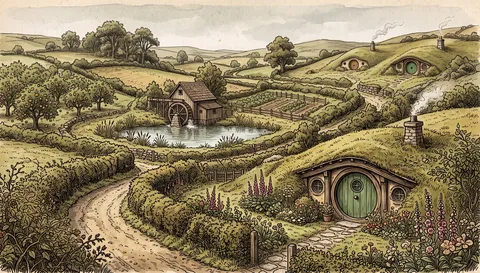
The company's history as a travelling party begins on the morning after the gathering at Bag End, when Bilbo caught up with the dwarves at Bywater and the whole party rode east on ponies. The first stretch through the Shire and the lands beyond was uneventful, but in the wilder country past the Last Bridge the weather turned and supplies ran short. Sent to scout a fire among the trees, Bilbo was caught by three trolls, and the dwarves who came after him were bagged one by one. Gandalf, who had rejoined the party, kept the trolls arguing among themselves until dawn caught them and turned them to stone. In the trolls' cave the company found a hoard, which they buried for later recovery, and three blades of ancient make, one of which Thorin took for himself and one of which became Bilbo's own sword.1
The travellers rested in Rivendell, where Elrond identified the recovered swords as work of the elves of Gondolin and discovered hidden moon-letters on Thror's map, which gave the conditions for opening a secret door into the Mountain. Crossing the Misty Mountains, the company sheltered from a storm in a cave that proved to be an entrance to the goblins' tunnels. They were taken captive, and Gandalf freed them by killing the Great Goblin, but in the flight through the dark Bilbo was separated from the others and found his way out alone. Beyond the pass, goblins and wolves trapped the party in the trees, and the Eagles carried them away. They were then sheltered and provisioned by Beorn before they set out to cross Mirkwood.2
At the edge of the forest Gandalf left the company for business of his own, and from then on the dwarves came to depend more and more on their burglar. In Mirkwood they left the path, lost themselves among the feast-lights of the Wood-elves, and were caught by giant spiders; Bilbo cut them free. Soon afterwards the Elvenking's people captured the dwarves and held them in his halls, with Thorin kept apart and refusing to say why they had come. Bilbo, unseen, set them loose by packing them into empty barrels that the elves floated down the river. So the company arrived at Lake-town, where Thorin declared himself heir of the King under the Mountain and the townsfolk received the party with feasting and later supplied them for the last stage of the road.3
On the western slopes of Erebor the company found the secret door, and it opened on Durin's Day as the map's writing had foretold. Bilbo went down alone into the dragon's hall, carried off a cup on his first visit, and on his second spoke with Smaug. The dragon, stung by the theft and suspecting help from the lake, came out of the Mountain and attacked Lake-town, where Bard shot him down. With Smaug dead, Men from the ruined town and an elvish host from Mirkwood marched on the Mountain to claim a share of the hoard. Thorin fortified the gate and refused all claims. Bilbo, looking for a way to peace, secretly handed the Arkenstone, the jewel Thorin prized above everything, to Bard as a bargaining piece. When this came out, Thorin cast the hobbit out of the company.4
The quarrel ended when Dáin arrived from the Iron Hills and a host of goblins and wolves came down on all the claimants together. In the Battle of Five Armies, dwarves, Men and elves fought on the same side, and Beorn and the Eagles joined them. Thorin was mortally wounded and made peace with Bilbo before he died. Fíli and Kíli fell defending him. Dáin became King under the Mountain and gave Bard a fourteenth share of the treasure, which was the same fraction once promised to the burglar. Bilbo took only a modest reward home, and the Tale of Years sets his return in the following year. With that the company, as a venture with a principal and a hired partner, came to an end.5
The surviving members stayed in the restored kingdom, and their later fortunes appear piecemeal in The Lord of the Rings. Some years after the quest, Balin came with Gandalf to visit Bilbo and reported that the valley under the Mountain was prospering. Balin later led a party to retake Moria, with Óin and Ori among his followers. The chronology gives his departure as 2989 and his death as 2994, and the Fellowship later found his tomb and the damaged record of the colony's fall. Glóin came to Rivendell with his son Gimli before the Council of Elrond and brought Bilbo news of the others, including the remark that Bombur had grown too heavy to move without help.6
- 1The Hobbit, Chapter 2, Roast Mutton
- 2The Hobbit, Chapter 3, A Short Rest; The Hobbit, Chapter 4, Over Hill and Under Hill; The Hobbit, Chapter 6, Out of the Frying-Pan into the Fire; The Hobbit, Chapter 7, Queer Lodgings
- 3The Hobbit, Chapter 8, Flies and Spiders; The Hobbit, Chapter 9, Barrels Out of Bond; The Hobbit, Chapter 10, A Warm Welcome
- 4The Hobbit, Chapter 11, On the Doorstep; The Hobbit, Chapter 12, Inside Information; The Hobbit, Chapter 14, Fire and Water; The Hobbit, Chapter 16, A Thief in the Night; The Hobbit, Chapter 17, The Clouds Burst
- 5The Hobbit, Chapter 17, The Clouds Burst; The Hobbit, Chapter 18, The Return Journey; The Lord of the Rings, Appendix B, The Tale of Years
- 6The Hobbit, Chapter 19, The Last Stage; The Lord of the Rings, Book II, ch. 1; The Lord of the Rings, Book II, ch. 5; The Lord of the Rings, Appendix B, The Tale of Years
Ways and Works of the Company
The company arrived at Bag End as a people with settled customs of dress and courtesy. Each dwarf came in a hood of a distinct colour, and each on entering offered his service to the host as part of the greeting, bowing low. They carried their own instruments, and after supper they played together in the hobbit's parlour: fiddles, flutes, clarinets, viols, a drum, and Thorin's harp. Their long song that evening was of old craft under the mountains, of worked gold and hidden halls, and of the dragon that ended it. While clearing the table they also sang a mock-threatening song about smashing the crockery, and broke nothing.1
Their craft was that of smiths and miners, and it shaped both their pride and their grievance. Thorin told Bilbo that in exile his people had worked as blacksmiths and even dug coal, a hard descent from the art of their fathers. Their marks and records were written in runes, and the map that led them east was one of these. Their reckoning of time was their own. Thorin explained at Rivendell that the dwarves' New Year fell on Durin's Day, the first day of the last moon of autumn, and that it could be foreseen only in years when the sun and the moon were in the sky together. The narrator describes dwarves without sentiment, as a calculating folk who set a high value on wealth. Some could be tricky, but they were decent enough if not much was expected of them.2
Their customs of death appear most clearly at the end of the venture. Thorin was laid deep within the Mountain with the Arkenstone upon his breast, and the Elvenking placed the sword Thorin had carried back upon the tomb. It was told afterwards that the blade gave warning in the dark whenever enemies drew near, so the gate could not be taken by surprise. Beyond such rites, the dwarves held that Aulë, who had made their fathers, would gather them after death to halls set apart for them in Mandos. That belief is recorded in the later-published account of the Elder Days rather than in the tale of the quest.3
Kindreds and Houses within the Company
Only the genealogy of Durin's line in the appendices to The Lord of the Rings sets out how the members of the company were related, and it accounts for fewer than half of them. At its centre stands the direct line of the kings: Thrór, his son Thráin, and Thráin's children Thorin, Frerin and Dís. Frerin had died in the war against the orcs of Moria long before the quest. Dís is the only dwarf-woman the table names, and her two sons are the youngest of the company. Thorin himself had no children, so these nephews were the next heirs of the house after him.1
Two pairs of brothers make up a collateral branch. Balin and Dwalin were sons of Fundin, and Óin and Glóin were sons of Gróin. Fundin and Gróin were themselves brothers, sons of Farin, who descended from a younger son of an earlier king. The four dwarves were therefore cousins of one another and distant kinsmen of Thorin, related through a common ancestor several generations back rather than through the reigning line. The same appendix records that Balin and Dwalin were among the few companions who went with Thráin when he set out on the wandering from which he never returned. Their loyalty to the house was already long established before Bag End.2
The other six members, Dori, Nori, Ori, Bifur, Bofur and Bombur, do not appear in the genealogy, and the published texts say nothing certain about their houses. In the tale they arrive at Bilbo's door in small groups and are named in sets, but their parentage is never stated. Only Thorin is ever described in terms of rank. The narrative presents him as the most important dwarf of the party, and the others defer to him in council and on the road. No other internal hierarchy is described.3
Role in the Story
In the tale the company is seen almost entirely through Bilbo's eyes, and it works less as a set of individuals than as the force that sets the story in motion. Most of the thirteen dwarves are hardly told apart. Thorin speaks for the party, and a few others receive a single distinguishing trait, but the rest move and suffer as a group. Their purpose, the recovery of a lost home and hoard, is the engine of the plot, while the book's real subject is what the journey does to the hobbit they hired. On the first evening it is their longing for the Mountain that wakes the adventurous Took side in Bilbo, and over the course of the road the arrangement slowly turns around. By the time the party stands before the dragon's door, the narrator remarks that the hired burglar had become their leader in practice.1
The commercial form of the company also carries the book's central moral test. A venture that counts its gains in shares is brought to the brink of ruin by the gains themselves, when the recovered treasure hardens Thorin against every other claim. Bilbo's answer is to treat his own share as something he can give away, spending it on a chance of peace rather than holding it. The reckoning comes at Thorin's deathbed, where he admits: “If more of us valued food and cheer and song above hoarded gold, it would be a merrier world.” The contract that opened the venture is thus answered by a judgement on the kind of value it had set out to measure.2
Seen from the later books, the company's modest undertaking acquires a larger place in the history of the age. At the close of the tale Gandalf reminds Bilbo that the old prophecies had come true through the adventure and that the hobbit had played only a small part in a wide world. The appendices to The Lord of the Rings go further. They present the quest as part of Gandalf's concern that a living dragon in the north could have served Sauron. They also record the wizard's later judgement that without the events at Erebor the war in the north would have gone far worse.3
The Company in Adaptation
The Rankin/Bass television film of 1977 keeps the company at its full strength of thirteen dwarves, but its short running time leaves most of them little more than names within the group. Thorin is the only member given a clearly separate voice and presence. Hans Conried voices him, with Orson Bean as Bilbo and John Huston as Gandalf. The film shortens the company's road east, and its best-known cut is Beorn, who does not appear at all. The party therefore passes from the eagles to the forest without the rest and provisioning that the book gives it at Beorn's hall. The film keeps the company's end in the battle below the Mountain, and Thorin's death, so the arc from contract to reckoning stays intact in outline.1
Peter Jackson's trilogy gives every member of the company a cast actor and a separate look, and so goes much further than the book in telling the thirteen apart. Richard Armitage plays Thorin, Ken Stott plays Balin and Graham McTavish plays Dwalin. Dean O'Gorman and Aidan Turner play Fíli and Kíli, and Martin Freeman plays Bilbo. The largest departures concern the company's enemies and its unity. Azog, whom the appendices record as killed in the war at Moria long before the quest, survives in the films and hunts Thorin's party across the whole journey. The company is also divided at Lake-town: Kíli is wounded and stays behind with Fíli, Óin and Bofur, so that only part of the company climbs to the secret door. Kíli is further given an attachment to Tauriel, an elf of Mirkwood created for the films with no counterpart in Tolkien's text. Unlike the book, where only the burglar goes down to the dragon, the films also bring the dwarves into open conflict with Smaug inside the Mountain before he flies against the lake.2