Names and Origin of the Company
The Fellowship was not a people in the usual sense. It had no ancestry, no homeland and no shared tongue, and it existed only by commission. It came into being at Rivendell, out of the deliberations of Elrond's council, once Frodo had offered to carry the Ring to Mordor himself. Before that, no company existed, only a scattered gathering of guests from many lands who had come, or been summoned, on separate errands. Its origin was a decision, not a descent, and its members kept their own kindreds and allegiances throughout.1
Within the narrative the group is most often called the Company of the Ring. That is Elrond's term, and the Tale of Years keeps it when it records the departure from Rivendell at dusk in late December. Elrond's second name, the Nine Walkers, is shaped as an answer rather than a description: it takes its meaning from the Ringwraiths it is set against, so the company is named by what it opposes. The form familiar to most readers, the Fellowship of the Ring, is best known as the title of the first volume. There it gathers the whole first movement of the story under the company's name.2
The make-up of the Nine was argued over before it was settled. Elrond at first meant to send the two younger hobbits home, or keep them in Rivendell, judging them unfit for what lay ahead. Gandalf spoke for them and held that friendship might serve better than foresight on such a road, so Elrond gave way. Other places were decided by the paths the travellers already meant to take. The Man from Gondor, for instance, was returning south to his own city in any case. The company was therefore partly chosen and partly assembled by circumstance, and the name was attached to it only once its number was complete.3
History of the Company
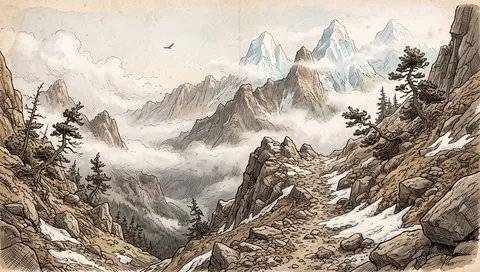
The Company's road began south along the western side of the Misty Mountains, marching mostly by night through the empty country of Hollin. There the travellers saw flocks of crows sweeping over the land and judged that they were being watched. Their first plan was to cross the mountains by the high pass beneath Caradhras. The attempt failed in a storm of snow so heavy that it seemed aimed at them. Forced back down the slopes, and harried by wolves on the night after, the Company accepted the course that had been urged from the start and turned toward the Doors of Durin and the old Dwarf-realm of Moria.1
Moria was the Company's first real loss. A creature in the dark pool before the western gate seized Frodo as the doors were opened and then shut them behind the travellers, so there was no way back. Within the mountain they learned from a damaged record that Balin's colony had been overrun. Soon afterwards they were attacked in the same chamber by orcs and a great troll. As they fled eastward a Balrog came upon them, and Gandalf held it on the narrow bridge and fell with it into the abyss. The Tale of Years sets his fall on 15 January 3019. From that point Aragorn led the Company, and he brought the eight survivors out through the eastern gate and down into the Dimrill Dale.2
In Lothlórien the Company found rest and was also tested. Galadriel met each of them with a searching look that several of them later felt as a private temptation. The time spent in the Golden Wood proved far longer than it had seemed to the guests, and Sam's count of moons did not agree with his memory. When they left, the Elves gave them boats, grey cloaks and waybread, and each traveller received a gift of their own. The Company then went down the Anduin toward the south. It was followed by Gollum, and on the night journey near the rapids it came under the bows of orcs from the eastern shore. Past the great carved figures of the Argonath the boats came to the lawn of Parth Galen, beneath the falls of Rauros, where the choice of road could no longer be put off.3
The Company broke apart on 26 February 3019. While the others debated, Boromir followed Frodo up the slopes and tried to take the Ring from him. Frodo escaped by putting it on, and on the seat of Amon Hen he decided to go on alone. Sam guessed his purpose and would not let him go without him, so the two crossed the river eastward together. At the same moment a band of orcs fell on the rest. Boromir died defending the two younger hobbits, and they were carried off as prisoners. Aragorn, Legolas and Gimli laid him in a boat and gave him to the falls. They then chose to pursue the captives rather than follow the Ring-bearer, and after this the Company never again travelled as one body.4
The separate parts of the Company came back together in stages during the War of the Ring. In Fangorn the three hunters met Gandalf, who had returned from death. Later, in the ruins of Isengard, they found Merry and Pippin sitting at their ease among the wreckage. Only after the Ring had been destroyed did all eight who still lived meet again, on the Field of Cormallen, where the two Ring-bearers were honoured before the host of the West. The fellowship continued through the months that followed. Its members were present at the crowning in Minas Tirith, and several of them rode north together on the road home until their paths diverged one after another.5
The Company ended over a long span of time, with one member after another passing out of Middle-earth. Frodo and Gandalf took ship from the Grey Havens in the autumn of 3021, and according to the tradition preserved in the Red Book, Sam followed after his wife's death many years later. Merry and Pippin ended their days in Gondor and were laid to rest near the king. The last departure came after Aragorn's death. Legolas then built a grey ship and sailed down the Anduin and over the Sea, taking Gimli with him. With that voyage the chronicle records that the Fellowship of the Ring had come to an end in Middle-earth.6
- 1The Lord of the Rings, Book II, ch. 3, The Ring Goes South; The Lord of the Rings, Book II, ch. 4, A Journey in the Dark
- 2The Lord of the Rings, Book II, ch. 4, A Journey in the Dark; The Lord of the Rings, Book II, ch. 5, The Bridge of Khazad-dûm; The Lord of the Rings, Appendix B, The Tale of Years
- 3The Lord of the Rings, Book II, ch. 7, The Mirror of Galadriel; The Lord of the Rings, Book II, ch. 8, Farewell to Lórien; The Lord of the Rings, Book II, ch. 9, The Great River
- 4The Lord of the Rings, Book II, ch. 10, The Breaking of the Fellowship; The Lord of the Rings, Book III, ch. 1, The Departure of Boromir; The Lord of the Rings, Appendix B, The Tale of Years
- 5The Lord of the Rings, Book III, ch. 5, The White Rider; The Lord of the Rings, Book III, ch. 8, The Road to Isengard; The Lord of the Rings, Book VI, ch. 4, The Field of Cormallen; The Lord of the Rings, Book VI, ch. 6, Many Partings
- 6The Lord of the Rings, Book VI, ch. 9, The Grey Havens; The Lord of the Rings, Appendix B, The Tale of Years
Bond, Gear and Custom on the Road
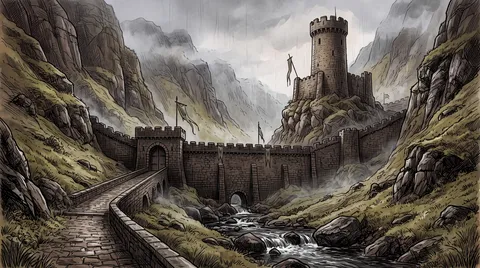
Unlike an order, the Company was held together by no vow. At its setting out Elrond laid the charge on the Ring-bearer alone. The others went as free companions, bound only to go as far as their will allowed and able to turn aside or come back if the road changed. When Gimli held that a vow might strengthen a faltering heart, Elrond answered that it might just as easily break one, and he left the matter to each traveller's own resolve. What the Company carried was likewise drawn from the separate histories of its members. Aragorn's broken sword had been forged anew in Rivendell. Frodo bore Bilbo's blade and his shirt of mithril rings beneath his clothes. A pony named Bill took the heavier baggage as far as the Doors of Moria.1
The travellers spoke the Common Speech among themselves, but each kept the lore and prejudices of his own kind, and these showed most sharply between Elf and Dwarf. On the borders of Lothlórien the Elves would admit Gimli only with his eyes bound. Aragorn resolved the quarrel by having the whole Company go blindfold alike, so that no one kindred was set apart. That settlement marked the turn in a friendship that grew steadily afterwards. In time Legolas and Gimli agreed that, once the war allowed, each would show the other the place he most loved, the forest of Fangorn and the caves behind Helm's Deep.2
The Company met death with song, though not in any single manner. In the Golden Wood the Elves made laments for Gandalf in their own tongue. Legolas would not render them into the Common Speech, because the grief was still too close to him. Frodo tried to shape his own sorrow into verse, and Sam added lines recalling the wizard's fireworks. After Boromir was given to the river, Aragorn and Legolas sang of him, each taking a different wind and asking it for tidings of the fallen man.3
- 1The Lord of the Rings, Book II, ch. 3, The Ring Goes South; The Lord of the Rings, Book II, ch. 4, A Journey in the Dark
- 2The Lord of the Rings, Book II, ch. 6, Lothlórien; The Lord of the Rings, Book III, ch. 8, The Road to Isengard
- 3The Lord of the Rings, Book II, ch. 7, The Mirror of Galadriel; The Lord of the Rings, Book III, ch. 1, The Departure of Boromir
Kindreds and Houses within the Company
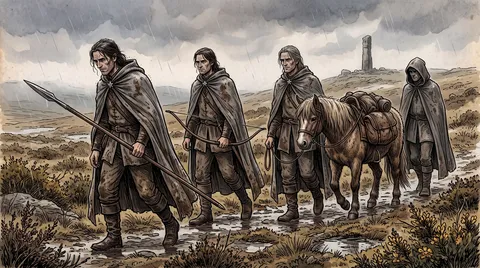
Although the Company was gathered to stand for the Free Peoples as a whole, its members never merged into one kindred, and the text keeps each of them within his own house. The two Men came from the two surviving branches of Númenórean descent. Aragorn, son of Arathorn, was the heir of Isildur and chieftain of the scattered Dúnedain of the North, a line that had kept its descent unbroken since the fall of Arnor. Boromir was the elder son of Denethor, the ruling Steward of Gondor, and he came to Rivendell from the southern realm on an errand of his own. His house held the rule of Gondor in trust for a king who had not returned, so the Company's two Men also embodied an unresolved question of lordship.1
The Elf and the Dwarf were each drawn from a named royal or noble line of the north. Legolas was a son of Thranduil, king of the Elves of northern Mirkwood, and had been sent to the council as his father's messenger. Gimli was the son of Glóin, one of Thorin's companions on the quest to Erebor, and belonged to Durin's Folk of the Lonely Mountain. He had travelled to Rivendell with his father. Gandalf stood apart from this scheme altogether. Elrond counted him as the Ring-bearer's companion rather than as the delegate of any people, and by nature he belonged to none of the kindreds the others represented.2
The hobbits made up almost half of the Nine, and the text distinguishes them carefully by family and standing. Frodo was a Baggins of Bag End and Bilbo's adopted heir, while Sam was the son of Hamfast Gamgee, the old gardener of the Hill. Merry was a Brandybuck, son of the Master of Buckland, and Pippin was a Took, son of Paladin and in the line of the Thains. Both of them were Frodo's kinsmen through his mother's and grandmother's families. The Prologue notes that Tooks and Brandybucks alike carried a marked Fallohide strain, which it associates with a taste for adventure uncommon among ordinary hobbits.3
- 1The Lord of the Rings, Book II, ch. 2, The Council of Elrond; The Lord of the Rings, Appendix A, I (iii) and (iv)
- 2The Lord of the Rings, Book II, ch. 2, The Council of Elrond; The Lord of the Rings, Book II, ch. 3, The Ring Goes South; The Lord of the Rings, Appendix A, III, Durin's Folk
- 3The Lord of the Rings, Prologue, 1, Concerning Hobbits; The Lord of the Rings, Appendix C, Family Trees
The Company in the Narrative
In the telling of the tale, the Company gives the first half of the story its shape. From Rivendell to the falls of Rauros the narrative follows one travelling group, and the reader sees the wider world through a band in which hobbits walk beside the heirs of kings. When the Company breaks, the structure of the book breaks with it. The next part follows those who stayed on the western side of the river, and the part after it follows Frodo and Sam alone on the eastern road, so the two threads run in separate books without meeting. The rest of the story is told as a braid of divided strands that close up again only near its end.1
What the Company stands for becomes clearest after it has ceased to travel together. Its scattered members turn up wherever the resistance to Sauron needs them. Pippin takes service under the Steward of Gondor, Merry offers his sword to the King of Rohan, and the others are drawn into the wars of both realms. The dispersal that looked like a defeat at Parth Galen places part of the Company inside each of the peoples that stand against Mordor. In this way the small fellowship of nine prefigures the larger alliance of the West, which is assembled only later and on a much greater scale.2
The book also treats the Company as something fragile rather than triumphant. Its danger comes from within as much as from outside, because the burden it guards presses on those who travel beside it. The tale therefore places its weight on individual loyalty rather than on the strength of the group. It is no longer the Company that reaches the Mountain of Fire, but only the Ring-bearer and the one companion who refused to leave him, and the task ends there without any of the others present.3
The Company in Film and Radio
Peter Jackson's trilogy gives the first of its three films the Company's name, and the first film follows the group from its forming at Rivendell to its breaking above the falls. Elijah Wood plays Frodo and Ian McKellen plays Gandalf. Viggo Mortensen plays Aragorn and Sean Astin plays Sam. Orlando Bloom and John Rhys-Davies play Legolas and Gimli, Sean Bean plays Boromir, and Dominic Monaghan and Billy Boyd play Merry and Pippin. The films change how the Company comes together. Elrond does not choose the Nine; its members offer themselves one after another at the council, and the two younger hobbits push their way into the group unasked, with no argument from Gandalf on their behalf. The films also call the group the Fellowship almost throughout, where the book mostly speaks of the Company. On the road, the storm on Caradhras is plainly the work of Saruman, which the book leaves open. Aragorn also sets out without his sword reforged; the blade is remade later and brought to him by Elrond only in the third film.1
The two older adaptations each show the whole Company. In Ralph Bakshi's animated film, Christopher Guard voices Frodo, William Squire voices Gandalf, John Hurt voices Aragorn, and Anthony Daniels voices Legolas. Because the film breaks off at Helm's Deep, it follows the Company only through its division and the first part of the war that comes after, and it never reaches the reunion of the survivors. The BBC's radio dramatisation carries the whole arc from the forming of the Company to its dispersal at the end. It casts Ian Holm as Frodo, Michael Hordern as Gandalf, Robert Stephens as Aragorn, and William Nighy as Sam. Michael Graham Cox, who voiced Boromir for Bakshi, plays the same part on radio, which links the two productions across the Company's ranks.2