Name and Etymology
Dunharrow belongs to the layer of names in The Lord of the Rings that Tolkien gave an Old English colouring. In his note on translation he explains that he rendered the speech of the Rohirrim through forms resembling ancient English, so that their tongue would stand to the Common Speech roughly as the old language of England stands to the modern one. Place-names in the Riddermark are shaped accordingly, and Dunharrow is best read as a modernised compound of two Old English elements rather than as an invented word.1
The first element corresponds to Old English dūn, a hill or upland, the same word that survives in modern down. The second continues hearg, an old term for a heathen sanctuary or place of worship, often set on high ground. Taken together, the name describes a holy place on the hillside, not merely a fort or shelter. This fits what the narrative shows at the site: a climbing road lined with carved figures and ranks of standing stones, remnants of a people older than the Riders, whose purpose the Rohirrim no longer knew. The Riders thus named the place after the sense of antiquity and old rites that clung to it, in their own tongue, while its makers remained unnamed. The same element recurs in Harrowdale, the valley below, which carries the name of the height above it.2
In speech the place is also called a hold, the term Gandalf uses when he advises Théoden to send his people into the hills. The word marks the site's function for the Rohirrim of the late Third Age, a stronghold of refuge, and stands beside the older religious sense preserved in the name itself. The standard German translation keeps this structure transparent: Dunharg and Hargtal carry the same second element through both names, so that the link between the height and its valley remains visible to German readers as well.3
Land and Place
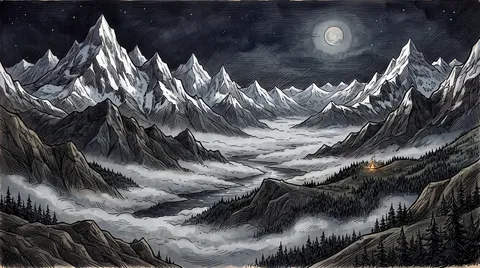
Dunharrow lies in the northern flank of the White Mountains, at the head of Harrowdale, the valley that runs up into the range south of Edoras. The Snowbourn comes down this dale from the heights and passes the royal town where the valley opens onto the plains, so the Hold and the seat of the king are joined by a single river-course, and a rider could go from one to the other by following the water upstream. Dunharrow is therefore not a fortress on the open grasslands of the Mark. It is a shelter pushed back into the mountains, behind the settled country.1
The site is built in levels. From the floor of the dale a road climbs the steep valley wall in a series of turns, and the Hold proper begins where that road reaches the top of the cliff and comes out on a broad, high meadow. This upland shelf looks back over the valley it has climbed out of, and behind it rise mountains on three sides, so that it forms a natural enclosure. The camp of the Rohirrim at the Muster was pitched on this meadow, with the king's quarters set upon it. The same arrangement of road and height made the place suitable as a last refuge. The ground behind the shelf offers no easy way onward, and anyone approaching from below must use the one climbing road.2
What distinguishes Dunharrow from other places of refuge is what lies at its back. Across the meadow a double line of rough, unshaped standing stones leads away from the edge of the cliff toward the mountain wall. It ends at a dark wood of black trees, the Dimholt, which stands beneath the Dwimorberg. In the rock beyond is the Dark Door, the entrance to the Paths of the Dead, and the Rohirrim held that way in dread and did not tread it. The Hold therefore faces two ways. Toward the valley it is a place of safety for the living, and toward the mountain it borders on a road that the Riders shunned.3
- 1The Lord of the Rings, Book V, ch. 3, The Muster of Rohan
- 2The Lord of the Rings, Book V, ch. 3, The Muster of Rohan; The Lord of the Rings, Book III, ch. 6, The King of the Golden Hall
- 3The Lord of the Rings, Book V, ch. 3, The Muster of Rohan; The Lord of the Rings, Book V, ch. 2, The Passing of the Grey Company
History
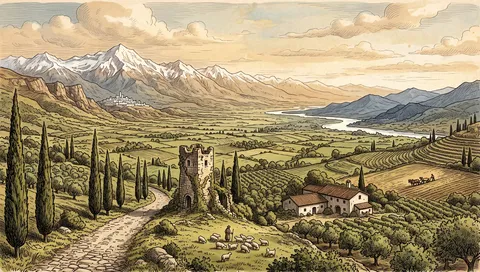
Dunharrow's history begins before the Rohirrim and before Gondor. By the time of the War of the Ring the Riders knew only that the climbing road, the carved figures and the upland field had been made by a people whose name no song or tale preserved. That people had worked there in the Dark Years, before any ship from the West reached the shores of Middle-earth and before the Dúnedain founded their realm in the south. Whether the makers meant the place as a town, a hidden temple or a burial ground for their kings, no one in Rohan could say. Nothing of them remained except the worn figures along the road, and the narrative gives no date for the founding.1
The Rohirrim took possession of the region after Eorl led them into Calenardhon in 2510, and the first recorded episode connected with the Hold falls in the reign of Brego, the second king. At the feast held in 2569 to hallow the newly completed hall of Meduseld, Brego's son Baldor rashly vowed to walk the Paths of the Dead. He went through the Dark Door behind Dunharrow and never returned, and Brego died of grief the following year. In Théoden's day the story was still told as the reason the Riders shunned that road. What became of Baldor was learned only in 3019, when the Grey Company found his remains inside the mountain before a door he had been unable to open.2
Dunharrow's role as a refuge is attested almost two centuries later, in the Long Winter of 2758–2759. When Rohan was invaded, the Dunlending Wulf occupied Edoras and King Helm was shut up in the Hornburg, and many of the people fled into the hills to Dunharrow. From there Fréaláf, Hild's son and so Helm's nephew, led a handful of desperate men down into the plain, caught Wulf unawares in Meduseld, killed him and won Edoras back. Helm and both his sons died in that war, so Fréaláf became king and founded the Second Line of the House of Eorl. The Hold therefore served as a last shelter for the people and a base for reconquest long before Gandalf counselled Théoden to use it.3
In March 3019, when Saruman made war on Rohan, Gandalf's advice was followed. Théoden rode west to fight at the Fords of Isen and in Helm's Deep, and Éowyn, left to govern in his place, led the people of Edoras up Harrowdale to the Hold. Aragorn, Legolas, Gimli and the Grey Company arrived ahead of the king. At daybreak on 8 March they passed the Dark Door. Éowyn had asked to go with them and been refused. Théoden reached Dunharrow soon afterwards and gathered the Riders of the Mark on the high field. There the errand-rider Hirgon came with the Red Arrow of Gondor, the summons to Rohan in its hour of need.4
The host rode out on 10 March, the Dawnless Day, when the darkness sent from Mordor was spreading over the land. Théoden had arranged for Éowyn to stay and rule the people who remained in the Hold, but she rode in secret with the host under the name Dernhelm and carried Merry with her. The departure of the Muster is the last event the narrative sets at Dunharrow. No enemy reached the Hold during the war, and it fulfilled its purpose as a refuge without ever being besieged.5
The long dread at the back of the Hold also came to an end in that year. The Dead who had followed Aragorn out of the mountain fulfilled their ancient oath in the fighting at Pelargir, and he released them, after which they were not seen again. The narrative does not record what became of Dunharrow after the War of the Ring. It gives no later assault, no ruin and no new function, and it leaves the Hold standing in the hills above Harrowdale as the Riders had found it.6
- 1The Lord of the Rings, Book V, ch. 3, The Muster of Rohan
- 2The Lord of the Rings, Appendix A, II, The House of Eorl; The Lord of the Rings, Book V, ch. 2, The Passing of the Grey Company; The Lord of the Rings, Book V, ch. 3, The Muster of Rohan
- 3The Lord of the Rings, Appendix A, II, The House of Eorl
- 4The Lord of the Rings, Book III, ch. 7, Helm's Deep; The Lord of the Rings, Book V, ch. 2, The Passing of the Grey Company; The Lord of the Rings, Appendix B, The Tale of Years
- 5The Lord of the Rings, Book V, ch. 3, The Muster of Rohan; The Lord of the Rings, Appendix B, The Tale of Years
- 6The Lord of the Rings, Book V, ch. 9, The Last Debate
People and Rule
The narrative gives Dunharrow no lord of its own. It appears as a possession of the Kings of the Mark, bound to the royal seat at Edoras. It was not a town with a settled population, but a place the people of the valley and the plain could fall back on when the land was threatened. Its authority was that of the king in Meduseld, carried up the dale with the people, and the Hold changed hands only as the kingship did. The line of kings descending from Eorl, through the break of the Long Winter into the Second Line, is therefore the only succession that can be attached to the site.1
How that authority was exercised when the king was absent is shown in some detail in 3019. When Théoden prepared to ride west, he asked who should lead the people in his place. Háma named Éowyn, arguing that she was fearless and that the Eorlingas held her in affection. The king accepted this before the assembled folk, so her rule over the refugees rested on his word and on their consent rather than on any office belonging to the Hold. At the Muster, Théoden confirmed her in that charge for those who were to stay behind. The narrative does not say who governed the people in the hills after she rode away in secret.2
The older inhabitants of the region are known only by their traces. The Rohirrim had no name for the makers of the road and its figures, and the narrative does not link them to any living people. The one hint of kinship comes far from the Hold. On the ride to Gondor, Merry thinks that Ghân-buri-Ghân, headman of the Wild Men of the Drúadan Forest, looks like one of the stone figures come to life. The mountain itself was associated with another people: the Dead who haunted the road behind the Hold were Men of the Mountains who had once broken their oath to Isildur. The text leaves open whether they had anything to do with the builders of Dunharrow.3
- 1The Lord of the Rings, Appendix A, II, The House of Eorl; The Lord of the Rings, Book III, ch. 6, The King of the Golden Hall
- 2The Lord of the Rings, Book III, ch. 6, The King of the Golden Hall; The Lord of the Rings, Book V, ch. 3, The Muster of Rohan
- 3The Lord of the Rings, Book V, ch. 5, The Ride of the Rohirrim; The Lord of the Rings, Book V, ch. 2, The Passing of the Grey Company
Role in the Story
In the narrative, Dunharrow is the point where the threads of Book V come together and then separate again. Two consecutive chapters approach it from different sides. The first brings Aragorn and his companions up the valley, and the second follows Merry, riding in the king's company, to the same height a little later. The reader therefore sees the Hold twice, and each visit is organised around a departure. The Grey Company leaves by the road into the mountain, and the Riders leave by the road down the dale. For a short time, the place where the people of Edoras are meant to wait out the war is also the place from which almost everyone of consequence goes away.1
The dramatic weight of these scenes falls on those who are told to stay. Éowyn's parting from Aragorn at the Hold is one of the few moments in which her hopes and her frustration are put into words. She speaks of being kept at home while others win renown, and his refusal leaves her grieving. In the following chapter Merry meets the same answer from Théoden, who judges him unfit for the ride and releases him from his promised service. Both refuse, in different ways, the safety that Dunharrow offers. The scene at the king's table, where Éowyn reports the passing of the Grey Company, joins the two figures before either has revealed what they intend.2
Much of the site's atmosphere comes to the reader through Merry's eyes. The hobbit notices the worn figures on the road with a curiosity close to pity, where the Riders pass them by without a glance, and he feels uneasy beneath the black mountain that closes the field. Through him, the Hold appears less as a fortress than as a place of waiting between two worlds, with older things at its back and the gathering darkness before it. When the Muster rides out beneath a lightless sky, the story leaves Dunharrow behind with the people who remained, and it does not return to them.3
- 1The Lord of the Rings, Book V, ch. 2, The Passing of the Grey Company; The Lord of the Rings, Book V, ch. 3, The Muster of Rohan
- 2The Lord of the Rings, Book V, ch. 2, The Passing of the Grey Company; The Lord of the Rings, Book V, ch. 3, The Muster of Rohan
- 3The Lord of the Rings, Book V, ch. 3, The Muster of Rohan
Adaptations
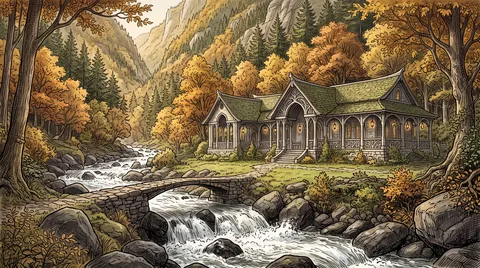
Peter Jackson's film trilogy moves the Hold's role as a refuge elsewhere. In the book, Gandalf's counsel sends the people of Edoras up Harrowdale under Éowyn while Théoden rides west. In the second film, the king instead leads the whole population to Helm's Deep, and the non-combatants shelter in the caves behind the Hornburg. Dunharrow therefore first appears in the third film, and there only as the gathering place of the Muster. The Rohirrim assemble in the valley after Gondor's beacons have been lit. The errand-rider bearing the Red Arrow has no part in the films, and the call for aid comes through the fires alone. Bernard Hill plays Théoden and Miranda Otto plays Éowyn, and her leave-taking from Aragorn and the king's refusal to take Merry are both kept at the Hold.1
The larger departure from the book concerns the road into the mountain. The films leave out the Grey Company, so Aragorn enters the Paths of the Dead with only Legolas and Gimli. He also sets out later than in the novel. There he and his companions go ahead of the king and are already gone when Théoden reaches the Hold. In the film, Aragorn leaves the encampment after the host has assembled, and only after Elrond, played by Hugo Weaving, has come to him there with the reforged sword. The book has no such visit, and Aragorn already bears the sword when he leaves Rivendell. Ralph Bakshi's animated film of 1978 breaks off after the battle at Helm's Deep and so never reaches the Muster or the Hold at all.2