Name and Naming
Morannon is a Sindarin name, and its meaning is transparent once divided: the first element is mor, dark or black, and the second is annon, the word for a great door or gate. The same prefix gives Mordor, the Black Land, and Moria, the Black Chasm, so the gate's name follows the land it closes. Annon also appears in the name of the Gate of the Noldor in the older histories, where it marks a passage through rock rather than a door in a wall. The index of name-elements appended to the Silmarillion lists Morannon under both roots, which confirms the division.1
Where the narrative first brings the gate into view, it names it both ways, the Elvish word and its English rendering placed side by side, and from then on the two are used interchangeably. The English form carries more weight in the book's structure. Both chapters in which the gate stands at the centre use it in their titles, one for the gate that remains shut to the hobbits and one for the gate that opens before the Captains of the West. The Sindarin name tends to appear where Men of Gondor or the narrator speak of the place as a fixed point on the map. The English form is used where the gate is experienced as an obstacle. Neither name is attributed to a particular speaker or occasion, and the text does not say who first gave it.2
The names around the gate belong to the same Elvish register. The defile it bars is Cirith Gorgor, glossed in the text as the Haunted Pass: cirith denotes a cleft or pass, and gorgor is a doubled form of gor, dread, meaning extreme horror. The two towers flanking the gate, Narchost and Carchost, are known together in English as the Teeth of Mordor, and both names end in the Sindarin element for a fortress. Since the towers were raised by Gondor, it is plausible that the Elvish names of the whole complex come from that realm, whose place-names were largely Elvish in form. The book, however, draws this conclusion only by implication, not in so many words.3
- 1The Silmarillion, Appendix, Elements in Quenya and Sindarin Names
- 2The Lord of the Rings, Book IV, ch. 3, The Black Gate is Closed; The Lord of the Rings, Book V, ch. 10, The Black Gate Opens
- 3The Lord of the Rings, Book IV, ch. 3, The Black Gate is Closed; The Lord of the Rings, Book VI, ch. 1, The Tower of Cirith Ungol; The Silmarillion, Appendix, Elements in Quenya and Sindarin Names
Situation and Shape
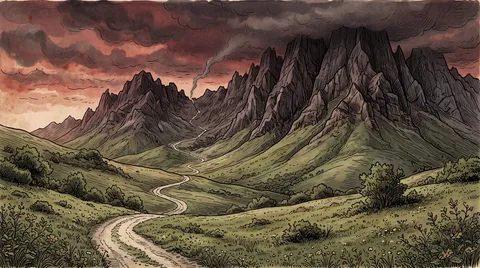
The Morannon stands at the north-western corner of Mordor, where the two mountain walls that fence the land on the west and on the north come close to meeting. The Ephel Dúath, the Mountains of Shadow, run down the western side, and the Ered Lithui, the Ash Mountains, run along the northern side. At the angle between them each range sends out a long arm, and the two arms bend towards one another. Between them opens the deep and narrow defile of Cirith Gorgor, and the gate is set across its mouth. The gate therefore faces outward, north-west, towards the waste of Dagorlad, the old Battle Plain. Beyond that waste lie the Dead Marshes, by which the hobbits and their guide came.1
The fortress is not a single building. It is made of two works of different age and different builders. The older work is the pair of towers that Gondor raised on the two hills standing forward from the defile. The younger work is a rampart of stone that the Dark Lord built later from cliff to cliff across the pass. This wall is pierced by one gate of iron, and guards walk its battlements without pause. The towers look out over the approach, and the wall seals the ground between them. The whole arrangement is a narrow closure with rising rock on either hand. An outpost of Gondor overlooking Mordor from outside was here made into a door that belonged to Mordor itself. The narrative draws the same comparison when it explains the tower above the pass of Cirith Ungol, another watch-post of Gondor that later fell into the Enemy's keeping.2
Behind the gate the pass leads into Udûn, a deep enclosed dale within the mountain angle. Udûn is shut in its turn by a second, inner narrows, the Isenmouthe, beyond which the way goes on into the plateau of Gorgoroth. The Morannon is thus the outermost of two locks on the northern entry into the land. In front of it the ground is spoiled and dead. Heaps of slag and blasted earth rise there like low hills, and between them lie pools of foul mire and reeking water. On two of these mounds the Captains of the West drew up their army. A road leaves the gate southward along the western feet of the Mountains of Shadow towards Ithilien and the Cross-roads. It is the way by which that army came north, and the way Gollum proposed as an alternative route when the gate proved impassable.3
- 1The Lord of the Rings, Book IV, ch. 3, The Black Gate is Closed; The Lord of the Rings, Book IV, ch. 2, The Passage of the Marshes
- 2The Lord of the Rings, Book IV, ch. 3, The Black Gate is Closed; The Lord of the Rings, Book VI, ch. 1, The Tower of Cirith Ungol
- 3The Lord of the Rings, Book VI, ch. 2, The Land of Shadow; The Lord of the Rings, Book V, ch. 10, The Black Gate Opens; The Lord of the Rings, Book IV, ch. 3, The Black Gate is Closed
History
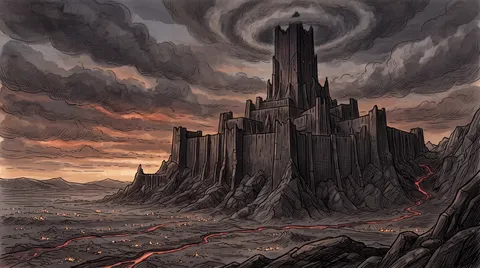
The pass that the Morannon later closed was a way into Mordor long before any gate stood in it. At the end of the Second Age, in the year 3434, the host of the Last Alliance crossed the mountains and defeated Sauron on Dagorlad, the plain that spreads before the entrance to his land. The siege of Barad-dûr began in the same year and lasted until his overthrow in 3441. The chronicle does not say whether anything barred the defile at that time. It records only the battle on the open ground in front of it, the ground where the last army of the West would stand again three ages of Men later.1
The first fortification the text describes belongs to Gondor. After Sauron had been cast down and had fled, the Men of Gondor raised the two towers on the hills at the mouth of the pass, to keep the defeated lord from reclaiming his former realm. No year is given for their building, and the narrative gives no date beyond placing it after that overthrow. Their purpose was a guard set outside the land and facing into it, part of a larger watch that also held the pass above Minas Ithil. For as long as Gondor was strong, the towers were manned, and the Black Land lay empty behind them.2
That watch did not outlast Gondor's strength. The Great Plague of the year 1636 of the Third Age struck the southern kingdom hard. Among its lasting harms, the annals of Gondor count the end of the guard on Mordor: the forts that held its passes were left without garrisons. The narrative of the hobbits' journey tells the same story from the side of the towers themselves. Their keepers grew slack, and for many years the Teeth stood empty. The appendices give no single year in which the towers passed into the Enemy's hands. By 1980, however, the Witch-king had come back into Mordor and gathered the Nazgûl there, and from then on the land was no longer empty.3
When Sauron himself returned, the purpose of the place was reversed. The decayed towers were restored, stocked with weapons and garrisoned under constant guard, and the wall with its iron gate was added across the pass. The Tale of Years sets Sauron's secret return to Mordor in 2942 and his open declaration of himself in 2951, but the narrative ties the repair of the Teeth to his return without fixing it to either year. In this form Frodo and Sam found the Morannon in March 3019. Hidden near the gate, they watched it open to let a marching company pass inward. They judged that no one could enter there unseen, so they took Gollum's road south instead.4
Only a few weeks later the Captains of the West brought their army north from Ithilien to the gate. The move was a deliberate challenge, meant to draw the Eye away from the Ring-bearer. Before the shut doors an envoy of the Dark Tower came out to parley. He displayed tokens taken from Frodo and demanded a surrender that Gandalf refused. The gate then opened, and the forces of Mordor came out through it while further hosts closed in from the hills on either side. The Tale of Years records that on 25 March the army was surrounded on the slag-hills. On that same day the Ring was destroyed in the Mountain of Fire.5
The fortress did not survive its master. When the Ring was unmade, the towers of the Teeth shook and collapsed, the wall across the pass broke apart, and the gate was thrown down in ruin. The defenders scattered, and the Captains of the West stood unopposed before the open pass. The tale tells of no attempt to raise the works again in the new age. Aragorn's settlement with the peoples of Mordor looked to the lands about Núrnen, not to the northern entrance. The Morannon therefore leaves the history as a ruin, built by the West to keep the Dark Lord out and later taken over by him to keep his land shut.6
- 1The Lord of the Rings, Appendix B, The Tale of Years
- 2The Lord of the Rings, Book IV, ch. 3, The Black Gate is Closed
- 3The Lord of the Rings, Appendix A, I (iv), Gondor and the Heirs of Anárion; The Lord of the Rings, Appendix B, The Tale of Years; The Lord of the Rings, Book IV, ch. 3, The Black Gate is Closed
- 4The Lord of the Rings, Book IV, ch. 3, The Black Gate is Closed; The Lord of the Rings, Appendix B, The Tale of Years
- 5The Lord of the Rings, Book V, ch. 10, The Black Gate Opens; The Lord of the Rings, Appendix B, The Tale of Years
- 6The Lord of the Rings, Book VI, ch. 4, The Field of Cormallen; The Lord of the Rings, Book VI, ch. 5, The Steward and the King
Garrisons, Masters and Neighbours
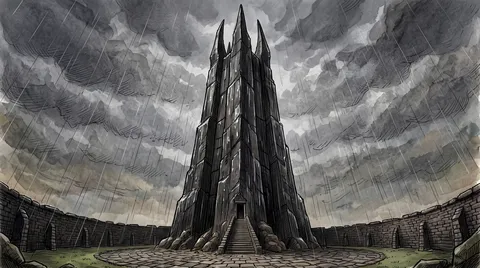
The Morannon was never a dwelling-place in the ordinary sense. It was a post held by garrisons for a distant master, and the book names no lord or captain who governed the gate itself. In Gondor's time the towers were kept by that realm's own soldiers, who answered to its kings and watched a land that lay empty of any people. When Sauron came back, the posts were filled with his servants. Orcs were quartered in the tunnelled rock beneath the hills, sentries kept the walls and the gate, and no traveller could pass unless the Dark Lord had called him or he held the words that opened it. Authority at the gate was therefore not local. It rested with the master in Barad-dûr, and the gate only carried out his will.1
In the last years the gate also served as the entry through which foreign peoples came into Sauron's service. From their hiding place Frodo and Sam watched a marching column go in, and it was made up of Men, not orcs. They were strangers from the broad lands of the East, answering their overlord's call, and they had camped outside the walls before they were admitted. Gollum told the hobbits that such companies came every day, from the East and from the South. When the gate was opened to the Captains of the West, the herald who rode out was himself a Man. He was the Lieutenant of the Tower of Barad-dûr, a renegade descended from the Black Númenóreans. His name had been forgotten, so he was known only by his office as the voice of his master.2
The gate's relation to the interior of Mordor was one of drawing strength outward. When the army of the West stood before it, Sauron gathered his forces towards the northern entrance. Orc companies were driven along the roads from Gorgoroth towards the Isenmouthe and the Morannon, and the hobbits were briefly caught up in one of these companies on their way to the Mountain. Among the forces that came out against the Captains were trolls brought from the hills of Gorgoroth, together with Easterling troops. The concentration at the gate left the inner plain thinly watched. It was this, more than anything built into the gate, that let the Ring-bearer cross the plain.3
- 1The Lord of the Rings, Book IV, ch. 3, The Black Gate is Closed
- 2The Lord of the Rings, Book IV, ch. 3, The Black Gate is Closed; The Lord of the Rings, Book V, ch. 10, The Black Gate Opens
- 3The Lord of the Rings, Book V, ch. 10, The Black Gate Opens; The Lord of the Rings, Book VI, ch. 2, The Land of Shadow
In the Story
The Morannon enters the tale as the place where the obvious road ends. Frodo has come across the marshes intending to go in by the one entrance he knows of, and the sight of the gate turns that intention into a choice with no good answer. He resolves to attempt it anyway, and only then does Gollum reveal that there is another way in. The chapter therefore turns less on the gate than on the hobbit's decision to trust his guide. Everything that follows in Book IV, from Ithilien to the stairs above the Morgul Vale, depends on a door that stayed shut.1
When the gate returns at the end of Book V, it has changed its role. The Captains know from Gandalf's counsel that no army of the West can take Mordor by force. They go to the gate precisely because it is the most visible place to stand, and the march is meant to hold the Enemy's gaze. The two chapters named for the gate mirror each other. The same threshold refuses the small travellers who seek to pass unseen and admits the great host that has come to be seen, and in both cases the real errand lies elsewhere. The gate is thus the book's clearest image of strength meeting strength, the path the story sets up in order to show that it cannot decide the war.2
The narrative also uses the place to close one line of the story and open another. Book V breaks off before the gate as Pippin falls beneath a troll he has struck down. His last thought is of Bilbo's old tale, as he hears a cry that the Eagles are coming. Book VI returns to that moment only after following the Ring to the Mountain, and it lets the Captains see from before the gate what the hobbits achieved within. Gimli later finds Pippin under the fallen troll. The gate thereby becomes the stage on which the host learns the outcome of a deed it could not see.3
- 1The Lord of the Rings, Book IV, ch. 3, The Black Gate is Closed
- 2The Lord of the Rings, Book V, ch. 9, The Last Debate; The Lord of the Rings, Book V, ch. 10, The Black Gate Opens
- 3The Lord of the Rings, Book V, ch. 10, The Black Gate Opens; The Lord of the Rings, Book VI, ch. 4, The Field of Cormallen
Adaptations
Of the screen and radio versions, Peter Jackson's film trilogy gives the Morannon its most prominent role. Its handling of the gate can be stated with confidence. The gate appears in two of the three films, following the division of the book, which places the hobbits' visit and the final confrontation in different volumes. In The Two Towers, released in 2002, Frodo, Sam and Gollum reach the gate and turn away from it. The film keeps the book's outline for this episode: the hobbits watch a company of Easterling Men admitted through the gate, and the scene ends with Gollum offering another road into the land. The Return of the King, released in 2003, brings the Captains of the West back before the gate for the final stand, and the fortress collapses when the Ring is destroyed.1
The best-known departure concerns the parley before the gate. In the version first shown in cinemas, the envoy of Barad-dûr does not appear at all, and the army proceeds straight from its arrival to the battle. The parley was restored only in the extended edition of the third film. There the herald is played by Bruce Spence and carries the book's title, the Mouth of Sauron. The restored scene still departs from the book. In the novel the herald flees back to the gate once his terms are refused, but in the extended film Aragorn kills him on the spot. Neither cut preserves the book's ending for Pippin at the gate, where the last chapter of Book V leaves him lying under a fallen troll. The films also give the defile's Elvish name, Cirith Gorgor, and the names of the two towers far less weight than the book does, and the English name serves as the usual designation throughout.2