Name and Naming
Harad is a Sindarin word, and its sense is simply 'south'. It is not the name of a single realm but a direction turned into a place name, much as the northerners of Gondor might speak of 'the South' without meaning any one kingdom. The same element appears in Quenya as hyar-, in the word for the southern quarter, so the Elvish tongues share a common root for the idea. The name therefore describes where the land lay in relation to those who named it, not anything about the land itself or the peoples living there. The work records no name that the southern peoples themselves used for their country.1
The name is a usage of the Dúnedain of Gondor, whose chief speech of lore was Sindarin, and it runs through the chronicles in Appendix A and the speech of Faramir's men. From the same stem come the Haradrim, 'people of the South', and the fuller form Haradwaith, which is used in the account of King Ciryandil's fall and which pairs harad with a second element also found in Enedwaith and Forodwaith. Gondor's own royal names draw on the same idea in the older tongue: the kingly name Hyarmendacil is built on the Quenya word for south, so a king's title recalls the land he had overcome. In the common speech of Gondor the dwellers of these lands are called Southrons, a plain Westron counterpart to the Elvish name.2
Because the name means no more than 'south', the text qualifies it by distance rather than by any border. It speaks of Near Harad, whose men once joined the Wainriders against Gondor, and of Far Harad, the remotest part of the South, from which strange warriors came in the War of the Ring. These are measures of how far a land lay from Gondor, not the names of two defined countries, and the work never draws a line between them. Umbar, though counted among the southern realms, keeps its own name and is not treated as another word for Harad.3
- 1The Silmarillion, Appendix, Elements in Quenya and Sindarin Names
- 2The Lord of the Rings, Appendix A, I (iv), Gondor and the Heirs of Anárion; The Lord of the Rings, Book IV, ch. 4, Of Herbs and Stewed Rabbit
- 3The Lord of the Rings, Appendix A, I (iv), Gondor and the Heirs of Anárion; The Lord of the Rings, Book V, ch. 6, The Battle of the Pelennor Fields
Land and Place
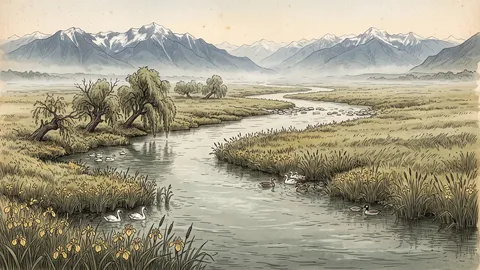
Harad is a region rather than a realm: a broad southern country lying below Gondor, reached by going south past the lands that Gondor itself held or claimed. The chronicles place it beyond the River Harnen, which served as the line an army from the north had to cross before it stood on southern soil. When Gondor was at its strongest, its reach extended south past the mouths of the Anduin, so that for a time the border between the kingdom and the South ran well below the river's delta. The same country appears as Haradwaith where Appendix A records a king of Gondor falling in battle there, so the account treats it as a real battlefield rather than a distant rumour. No single border for Harad is ever drawn; the text knows only where Gondor's power ended and the South began.1
Two ways connected the South with the lands of the north. Overland, an old road ran down through Ithilien, and by it the Southron hosts marched north toward Mordor in the days before the War of the Ring; Faramir's rangers lay in wait for them along that route. Along the coast lay Umbar, a haven counted among the southern realms and the one closest to Gondor, so that the South was bound to its northern neighbour by sea as well as by land. The roads and the haven explain why Harad, remote as it was, could send armies to the Anduin and the Pelennor.2
Harad's full extent is left open. Aragorn speaks of having travelled in the far countries of Rhûn and Harad, where the stars overhead were unfamiliar to northern eyes, which suggests how far south the land reached. Its most distinctive creatures were the mûmakil, the great war-beasts brought north from the South that Sam had previously known only from old rhymes. The peoples it sent to war were not uniform either, since warriors from its remotest parts looked strange even beside the other Southrons. The work describes Harad as a vast, varied South seen from Gondor's border, not as a mapped country.3
- 1The Lord of the Rings, Appendix A, I (iv), Gondor and the Heirs of Anárion; The Lord of the Rings, Book IV, ch. 4, Of Herbs and Stewed Rabbit
- 2The Lord of the Rings, Book IV, ch. 4, Of Herbs and Stewed Rabbit; The Lord of the Rings, Appendix A, I (iv), Gondor and the Heirs of Anárion
- 3The Lord of the Rings, Book II, ch. 2, The Council of Elrond; The Lord of the Rings, Book IV, ch. 4, Of Herbs and Stewed Rabbit; The Lord of the Rings, Book V, ch. 6, The Battle of the Pelennor Fields
History
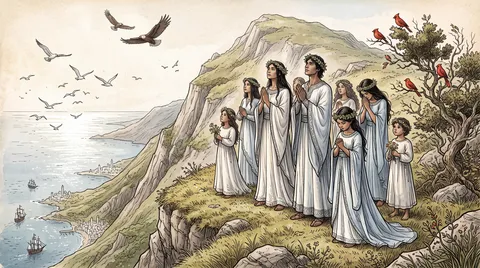
The recorded history of Harad begins in the Second Age, when the South first came within reach of the Númenóreans. As their power grew on the coasts of Middle-earth, those of them who turned to Sauron's service made their seats in the southern lands, and two of these, Herumor and Fuinur, gained great power among the Haradrim. The South thus entered the chronicles already bound to the Shadow through lords of western descent, a tie that later history would repeatedly draw upon. Gondor, founded after the fall of Númenor, inherited a southern frontier that was never peaceful for long. In later times its people remembered contacts with the kingdoms of the Far South reaching back into the distant past, yet those dealings had never ripened into friendship.1
Open war between Gondor and the South belongs to the age of Gondor's ship-kings. After Eärnil I took the haven of Umbar, the Men of Harad, under the lords who had been driven from that haven, came against it in force, and King Ciryandil, Eärnil's son, was killed fighting in Haradwaith in 1015 of the Third Age. Umbar was then besieged for years but held, because Gondor still commanded the sea. Ciryandil's son Ciryaher spent the early years of his reign gathering strength, and in 1050 he moved south by land and sea together. His armies crossed the Harnen and broke the Men of the Harad so completely that their kings were forced to accept Gondor as overlord and to send their sons to live at his court as hostages. Ciryaher took the name Hyarmendacil for this victory, and the Tale of Years marks it as the moment Gondor stood at the peak of its strength.2
That overlordship did not last. As Gondor weakened through civil strife, plague and invasion from the east, the South regained its independence and became a standing threat on the kingdom's southern flank. In 1944, when the Wainriders assailed Gondor from the east, men of Near Harad joined them together with men of Khand, so that the kingdom was attacked from two directions at once. The southern host was defeated in South Ithilien by Eärnil, the captain who commanded Gondor's southern army and who afterwards turned north to destroy the Wainriders as well. The episode shows the South acting not alone but as part of a wider alliance against Gondor, a pattern that would recur.3
As Sauron's power revived in the later Third Age, the Haradrim were drawn increasingly into his designs. In 2885, stirred up by his emissaries, they crossed the River Poros and invaded Gondor, and the twin sons of King Folcwine of Rohan fell fighting in Gondor's service during that war. By the years before the War of the Ring, southern armies were travelling openly northward toward Mordor to join the Dark Lord's gathering forces. The South had by then passed from being a rival of Gondor to being one of the reservoirs from which Sauron drew his strength.4
In 3019 the peoples of Harad took part in the assault on Minas Tirith. At the Battle of the Pelennor Fields their infantry advanced from the south with cavalry in front and mûmakil at the rear, and among them fought warriors from the farthest South who seemed half-troll to the defenders. Théoden of Rohan overthrew their chieftain, who rode beneath a black serpent standard, before the king himself was struck down, and the southern host was ultimately destroyed on the field. Southrons were also among the forces that met the Captains of the West before the Black Gate. After Sauron's fall, King Elessar concluded peace with the peoples of Harad, and with that settlement the long history of enmity between Gondor and the South comes to its recorded close.5
- 1The Silmarillion, Of the Rings of Power and the Third Age; The Lord of the Rings, Book IV, ch. 4, Of Herbs and Stewed Rabbit
- 2The Lord of the Rings, Appendix A, I (iv), Gondor and the Heirs of Anárion; The Lord of the Rings, Appendix B, The Tale of Years
- 3The Lord of the Rings, Appendix A, I (iv), Gondor and the Heirs of Anárion
- 4The Lord of the Rings, Appendix B, The Tale of Years; The Lord of the Rings, Book IV, ch. 4, Of Herbs and Stewed Rabbit
- 5The Lord of the Rings, Book V, ch. 6, The Battle of the Pelennor Fields; The Lord of the Rings, Book V, ch. 10, The Black Gate Opens; The Lord of the Rings, Book VI, ch. 5, The Steward and the King
Peoples and Rule
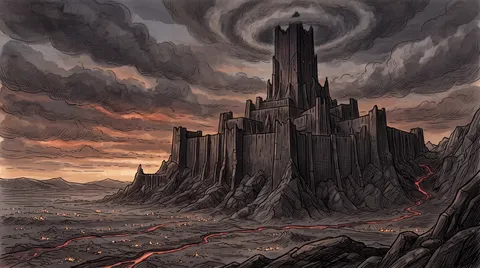
The dwellers of the South appear in the work only as others saw them, and those observers never treat them as a single people. The book speaks of the peoples of Harad in the plural, and it groups their fighters by distance rather than by nation: Southrons of the nearer lands on the one hand, and on the other the men of the remotest South, whose appearance struck Gondor's defenders as wholly alien. The descriptions come from Gollum, Sam and the rangers of Ithilien. They tell of men who were large and fierce, dark-eyed and black-haired, who wore gold as ornament and often went dressed in red, and a fallen Southron in Ithilien is seen to have a brown hand. Their taming and use of the mûmakil in war marks them off from every northern people. Nothing is recorded of their own speech, customs or beliefs, and the text does not fill that silence.1
Rule in the South was divided. The chronicles of Gondor name no single throne there, only several kings, each at the head of one of the southern kingdoms, and no ruler of Harad is ever given a personal name. Power along the coast was also held by strangers for long stretches. After the Kin-strife, the defeated followers of Castamir withdrew to Umbar, which became a realm hostile to Gondor and a refuge for its enemies. When Gondor's own troubles deepened after King Telumehtar had retaken that haven, it slipped from Gondor's grasp once more and passed into the hands of the Men of Harad. The line between the southern kingdoms and the lords who ruled among them was therefore never fixed. Southern power shifted according to who held Umbar and how strong Gondor happened to be.2
In the Third Age the South's dealings with its neighbours were shaped by Gondor on one side and the Dark Tower on the other. Gondor thought of the Southrons as a frontier enemy, sometimes subdued and sometimes resurgent. The alliances the South made were with Gondor's foes, among them the men of Khand in the east and, in the end, Mordor. The work nonetheless allows the individual Southron a measure of sympathy. As Sam looks at the dead warrior in Ithilien, he wonders what the man's name was, where he came from, and whether lies or threats had driven him on the long march north. The narrative implies that the men of the South were drawn into Sauron's war more than they chose it.3
- 1The Lord of the Rings, Book IV, ch. 3, The Black Gate is Closed; The Lord of the Rings, Book IV, ch. 4, Of Herbs and Stewed Rabbit; The Lord of the Rings, Book V, ch. 6, The Battle of the Pelennor Fields
- 2The Lord of the Rings, Appendix A, I (iv), Gondor and the Heirs of Anárion
- 3The Lord of the Rings, Book IV, ch. 4, Of Herbs and Stewed Rabbit; The Lord of the Rings, Appendix A, I (iv), Gondor and the Heirs of Anárion
In the Story
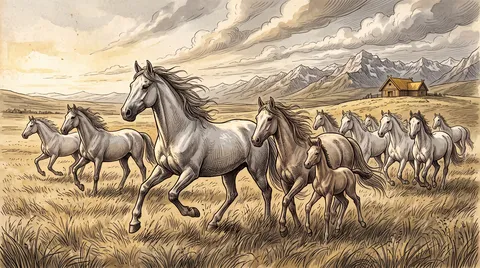
Harad is one of the few great regions of the book that the narrative never enters. No character's journey leads into the South, and no scene is set there. It exists at the edge of the story, and the reader learns of it only as it comes north. It first appears as report rather than sight. While the hobbits wait before the Black Gate, Gollum tells of men from the South moving along the roads into Mordor and of the great beasts that march with them, and Sam presses him for news of oliphaunts. For the reader, Harad begins as rumour passed through an unreliable guide, and the rumour points to Mordor's pull reaching far beyond any land the hobbits know.1
The rumour gains substance in Ithilien, where the South is seen for the first time at close range. The armies Gollum described turn out to be real columns on a real road. A single mûmak crashing through the woods gives a creature out of hobbit lore a body and a weight. On the Pelennor the South changes the shape of the battle itself: the horses of Rohan will not go near the mûmakil and swerve away from them, so the charge that had swept the field meets its first real check against the southern host. Harad gives the war its scale, showing that Sauron's summons reached peoples and beasts far beyond the familiar north.2
The South's last appearance in the war is a turning away rather than a defeat in arms. When the Dark Tower falls, the Men of Harad and Rhûn who stand in the field see their cause undone. Some flee, while others lay down their weapons and ask for mercy. The book thus lets Harad pass out of the story as a people released from a master's will, not as an enemy destroyed. This leaves room for the settlement that follows, and it fits the book's recurring suggestion that the South served the Shadow without belonging to it.3
Drafts and Variants
The drafts add little to the geography of the South, but they do show where Tolkien placed its name in his etymological scheme. In the Etymologies, the root word-list he compiled in the 1930s, harad already appears with the meaning 'south'. It is attributed there to Noldorin, the name Tolkien then gave to the Elvish tongue that later became Sindarin, so the word is older than the language it now belongs to. The list derives the word from a root meaning 'left hand'. The same base produces a Quenya adjective for 'left' and the Quenya noun for the south, and the Noldorin side has a word for 'left' alongside harad. A parallel root for 'right' yields the Elvish terms for north. Taken together, the two entries treat the cardinal points as sides of the body rather than as abstract directions, and the pairing of left with south and right with north implies a speaker facing west. The later texts keep the word harad and its meaning but do not repeat the derivation.1
- 1The Lost Road and Other Writings, Part Three, The Etymologies
In Adaptation
Harad has its largest screen presence in Peter Jackson's film trilogy, and even there it appears only as it does in the book, through the armies it sends north. None of the three films sets a scene in the South or gives its lands any shape of their own. The region is known through the Southron soldiers and their war-beasts. The Southron column that Faramir's men ambush in Ithilien is kept in The Two Towers, and the mûmakil join the assault on Minas Tirith in The Return of the King. The most discussed departure concerns the dead Southron in Ithilien. In the book the thoughts about the fallen man, his name, his home and what drove him so far from it, belong to Sam. The film moves this reflection to Faramir, so the sympathy the book grants the Southrons now comes from a captain of Gondor rather than from a hobbit seeing such a man for the first time. The films also end without showing the peace King Elessar makes with the peoples of Harad, so the South leaves the story as an enemy on the battlefield and never becomes a partner in the settlement that follows.1
The older adaptations give the South less room. Ralph Bakshi's animated film breaks off after Helm's Deep, before the story reaches Ithilien or the fields before Minas Tirith. The Southron hosts therefore play no part in it, and the war in which they fight was left to the second film that was never made. The later adaptations drawn from Tolkien's other material, the Hobbit trilogy and the animated War of the Rohirrim, are set in the north and the west and do not take up the history of Gondor's southern wars.2