
Name and Naming
In The Lord of the Rings the name Rhûn does double duty. It designates a wide and vaguely bounded country in the east of Middle-earth, and it also names the inland sea that lies within or before it, so that the narrative speaks both of Rhûn itself and of the Sea of Rhûn. The name comes almost entirely from western speakers: Aragorn at Rivendell, the chroniclers of Gondor, and the annals of Rohan. For them it marks the outer edge of the known world rather than a territory they had mapped. In Aragorn's account the name is paired with Harad, and the pairing is revealing, since the two function less as the names of realms than as the far quarters of the compass, east and south, seen from the West. The inhabitants are likewise described from outside, as Men of Rhûn or Easterlings, and the text never records what these peoples called their own lands or themselves.1
The word itself is Sindarin and means simply 'east'. The glossary of name-elements appended to The Silmarillion lists it in that sense and gives the Quenya word rómen, whose meanings run from 'uprising' and 'sunrise' to 'east'. The same Quenya element recurs in Rómenna, the eastward-facing haven of Númenor. The Sindarin form therefore places the name within the Elvish-derived nomenclature that the Dúnedain used for the lands about them, and it records a bearing rather than a description. Nothing in the name refers to the landscape, the people, or the sea. It says only in which direction the country lay from those who spoke of it, and that directional quality fits the way the West knew Rhûn: as a horizon toward which armies, hunters, and in the end kings looked or rode.2
- 1The Lord of the Rings, Book II, ch. 2, The Council of Elrond; The Lord of the Rings, Book VI, ch. 4, The Field of Cormallen; The Lord of the Rings, Appendix A, I (iv), Gondor and the Heirs of Anárion
- 2The Silmarillion, Appendix, Elements in Quenya and Sindarin Names, rhûn; The Silmarillion, Appendix, Elements in Quenya and Sindarin Names, rómen
Land and Place
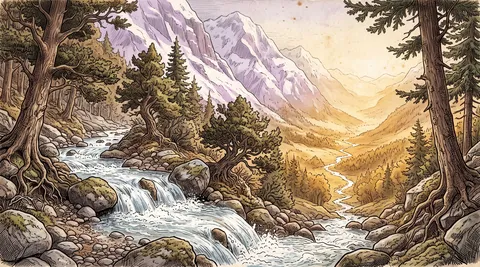
Rhûn lies in the east of Middle-earth, beyond the lands that Gondor and its northern neighbours knew at first hand. The one feature the text fixes with any firmness is its inland sea. The chronicles of Gondor use that sea as a boundary marker. When the southern kingdom stood at its widest under Hyarmendacil I, its dominion ran eastward until it met the shore of the Sea of Rhûn, just as it ran north to the field of Celebrant and the southern edge of Mirkwood, west to the Greyflood and south to the Harnen. The sea thus appears first as the limit of another realm's reach, and only by implication as the threshold of a land lying further on. Whether the country of Rhûn began at that water or already enclosed it, the appendices do not say.1
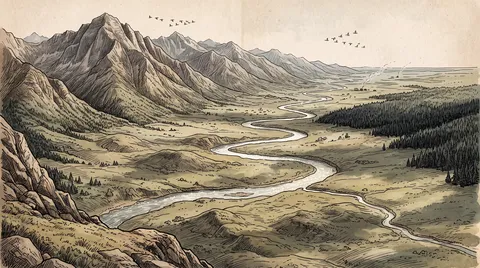
Of the land itself the narrative preserves only glimpses, and they suggest broad, open country. The account of Minas Tirith recalls that Vorondil rode into the distant plains of Rhûn to hunt the wild kine of Araw, and that the horn later carried by Boromir came from one of these beasts. Game of that kind points to wide grazing lands rather than forest or mountain. The country also extended well past the sea. In the years after the War of the Ring, Éomer and the riders of the Mark followed King Elessar into the lands beyond it, and the annals of Rohan record that the sound of their cavalry was heard there. Rhûn therefore reaches eastward from its sea into regions that no western source goes on to describe.2
What the texts withhold is as characteristic as what they give. No frontier of Rhûn is drawn, no river or city within it is named, and its distance from Gondor or Rohan is never stated. Its people enter the story as hosts marching west in Sauron's service, among them those gathered before the Black Gate who watched their war collapse, rather than as the inhabitants of a described homeland. When Aragorn tells the Council that his wanderings took him as far as Rhûn, he conveys its remoteness through unfamiliar stars overhead rather than through any feature of the ground. The region is known, in short, by its sea, its far grasslands and its bearing from the West, and everything else lies outside what the western sources record.3
- 1The Lord of the Rings, Appendix A, I (iv), Gondor and the Heirs of Anárion
- 2The Lord of the Rings, Book V, ch. 1, Minas Tirith; The Lord of the Rings, Appendix A, II, The House of Eorl
- 3The Lord of the Rings, Book VI, ch. 4, The Field of Cormallen; The Lord of the Rings, Book II, ch. 2, The Council of Elrond
History
Rhûn has no recorded founding. The western sources never describe its settlement, its peoples' origins or any realm that arose within it, so its history comes down only as a sequence of encounters seen from Gondor and, later, from Rohan. Those encounters begin early in the Third Age. The chronicles of the southern kingdom say that in the reign of Ostoher wild Men from the east first attacked Gondor's borders. His son Tarostar drove them back and took the royal name Rómendacil, 'victor of the East', and the Tale of Years dates that victory to the year 500. Rómendacil I later fell fighting against the Easterlings in 541, and his son Turambar avenged him and extended Gondor's territory eastward. The annals speak of these enemies as coming out of the East. They do not name Rhûn as their homeland, and the connection should not be pressed further than the texts allow.1
The inland sea enters Gondor's history as a scene of war only after the kingdom's peak under Hyarmendacil I, whose eastern frontier has been described above. Two centuries later the pressure from the east returned. Minalcar, who governed as regent for his uncle Narmacil I and later reigned as Rómendacil II, answered it in 1248 with a major campaign. According to the appendices, he broke a great Easterling army in the lands between Rhovanion and the Sea of Rhûn and destroyed their camps and settlements on the far side of the sea. On this occasion a Gondorian army is recorded as reaching beyond the water, not merely using it as a boundary. After the victory Minalcar also adopted the old title of East-victor. He then set about securing the eastern approaches by binding the Northmen of Rhovanion to Gondor and fortifying the western shore of the Anduin, so that a friendly people stood between the kingdom and whatever lay farther east.2
In the centuries that followed the balance shifted against the West. From 1851 a people the chronicles call the Wainriders, who moved across the plains in wagons, began to attack Gondor from the east. In 1856 Narmacil II fell in battle and the kingdom lost its lands beyond the Anduin. Calimehtar won a great victory over the invaders on the Dagorlad in 1899. In 1944, however, they overwhelmed King Ondoher and both his sons, and they were driven off only when Eärnil fell upon their camp and destroyed it. Later still, in 2510, the Balchoth came out of the east and crossed the Anduin, and Gondor was saved only by the arrival of Eorl and his riders at the Field of Celebrant. The sources place all these assaults in the east broadly. They record Gondor's losses and recoveries in detail but say nothing of the lands from which the attackers set out.3
In the War of the Ring the East served Sauron on more than one front. Easterlings fought in the host that assailed Minas Tirith and were among the forces on the Pelennor. In the North, the Tale of Years records that a great army of Easterlings crossed the River Carnen in 3019, drove King Brand back to Dale and fought the Battle of Dale on the seventeenth of March, in which Brand and Dáin Ironfoot were both killed and the survivors were besieged in Erebor. Only after Sauron's fall were the Easterlings dispersed there. The collapse of the eastern hosts before the Morannon has been noted in an earlier section. Taken together, these accounts show that the peoples of the East fought across a front that ran from the Lonely Mountain to the Pelennor.4
The Fourth Age opens with a settlement rather than a conquest. After his crowning, King Elessar pardoned the Easterlings who had surrendered and released them to return home, and he made peace with the peoples of Harad. Embassies from the East and the South came to the restored kingdom. The later campaign in which the horsemen of Rohan followed the king past the inland sea is recorded in the annals of the Mark, but no source says that Rhûn was annexed, garrisoned or brought under Gondor's rule. The region therefore leaves the record as it entered it: a neighbour beyond the frontier, sometimes at war with the West and sometimes at peace with it, whose own history the western chronicles never set down.5
- 1The Lord of the Rings, Appendix A, I (iv), Gondor and the Heirs of Anárion; The Lord of the Rings, Appendix B, The Tale of Years
- 2The Lord of the Rings, Appendix A, I (iv), Gondor and the Heirs of Anárion; The Lord of the Rings, Appendix B, The Tale of Years
- 3The Lord of the Rings, Appendix A, I (iv), Gondor and the Heirs of Anárion; The Lord of the Rings, Appendix A, II, The House of Eorl; The Lord of the Rings, Appendix B, The Tale of Years
- 4The Lord of the Rings, Book V, ch. 6, The Battle of the Pelennor Fields; The Lord of the Rings, Appendix B, The Tale of Years
- 5The Lord of the Rings, Book VI, ch. 5, The Steward and the King; The Lord of the Rings, Appendix A, II, The House of Eorl
Peoples and Rule
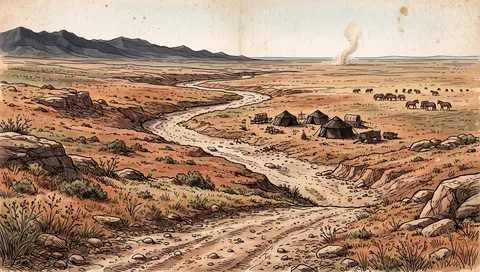
The western sources never describe the inhabitants of Rhûn on their own terms. They know them only under collective names given from outside, as Men of Rhûn, Easterlings, or the names of particular invading hosts. The fullest characterisation concerns the Wainriders, whom the chronicles of Gondor present as either a single people or a confederacy of many tribes, better armed and more formidable than the eastern raiders who had come before them. Beyond that the record is silent. No king, chieftain, dynasty or seat of government in Rhûn is named, no law or custom is reported, and the language of its peoples is never mentioned. The only eastern dwellings the appendices notice are the camps and settlements that Gondor destroyed, and nothing indicates whether the lands around the sea formed one realm, many, or none.1
What the texts do record is how the eastern peoples stood toward their neighbours, and there they appear repeatedly as members of alliances. In the campaign of 1944 the Wainriders coordinated their assault with the Men of Khand and Near Harad, so that Gondor faced attack from the north and the south together. The same pattern returns in the War of the Ring. On the Pelennor, Easterlings fought beside the Variags of Khand and the Southrons, and at the end of the war the Men of Rhûn and of Harad are named together as the peoples whose cause failed with Sauron's. In each case the eastern hosts serve a larger design directed against Gondor rather than any recorded aim of their own. Whether these peoples obeyed Sauron as subjects, as allies, or under some other bond, the narrative does not say.2
Against this record of war stands a single hint of contact of another kind. Aragorn counts Rhûn among the far countries through which he travelled before the War of the Ring, which implies that a lone traveller from the West could pass among its peoples. He gives no account of whom he met or who ruled there, and the text records the journey only as a measure of how far his wanderings took him.3
- 1The Lord of the Rings, Appendix A, I (iv), Gondor and the Heirs of Anárion
- 2The Lord of the Rings, Appendix A, I (iv), Gondor and the Heirs of Anárion; The Lord of the Rings, Book V, ch. 6, The Battle of the Pelennor Fields; The Lord of the Rings, Book VI, ch. 4, The Field of Cormallen
- 3The Lord of the Rings, Book II, ch. 2, The Council of Elrond
Role in the Story
Rhûn is never a setting in The Lord of the Rings. No chapter takes place there, none of the principal characters is shown arriving or departing, and the narrative mentions the region only in speech, in memory, or in the later annals. Its role is therefore that of an offstage horizon. It marks how far the world of the story extends beyond the ground the reader actually crosses. The first time it serves that purpose is at the Council of Elrond, where Aragorn cites his travels into Rhûn in answering Boromir, and the far East becomes evidence of his long, unseen labours rather than a place with a history of its own.1
The region's most intimate link to the plot is an object, the horn Boromir carries. He sounds it at Amon Hen in his last fight. Later, Faramir tells of hearing its call far off and of finding it split in two, drifting with the river. When Pippin first stands before Denethor, the steward holds the two halves, and the story of the ancient hunt in the eastern plains is told at that moment. A thing taken from Rhûn's distant pastures thus becomes the token by which Gondor learns of Boromir's death, and the East enters the heart of the story as a relic of loss, not as a landscape.2
In the closing movement, Rhûn stands for the enemy's reach and for its limit. Its hosts are among those whose cause falls apart before the Black Gate, and from then on the narrative no longer treats the East as a threat. The appendices supply a quiet coda in which the horsemen of the Mark ride with the restored king beyond the eastern sea. The land that first appeared as the farthest point of a Ranger's lonely wanderings now appears as the farthest point of a reunited West's campaigns. Across the book, Rhûn therefore works mainly as a measure of distance, first for a single traveller and at the end for a kingdom.3
- 1The Lord of the Rings, Book II, ch. 2, The Council of Elrond
- 2The Lord of the Rings, Book III, ch. 1, The Departure of Boromir; The Lord of the Rings, Book IV, ch. 5, The Window on the West; The Lord of the Rings, Book V, ch. 1, Minas Tirith
- 3The Lord of the Rings, Book VI, ch. 4, The Field of Cormallen; The Lord of the Rings, Appendix A, II, The House of Eorl
Drafts and Variants
Tolkien's drafts say little about Rhûn as a place, and what can be traced with confidence concerns the word more than the land. In The Etymologies, the dictionary of roots that Tolkien kept in the later 1930s and that Christopher Tolkien printed in The Lost Road, the word appears under the base RŌ-, which denotes the rising of the sun and other heavenly bodies. There the Elvish word for 'east' is filed not as Sindarin but as Noldorin, the name Tolkien then used for the tongue that later became Sindarin. The draft entry therefore records the word under an earlier idea of whose speech it belonged to, before Tolkien recast the linguistic history of the Elves and moved this vocabulary to the Grey-elves of Beleriand. It also shows that the element existed in his languages before it became the name of a country in The Lord of the Rings. Neither the root entry nor its commentary treats the word as the name of a region or a sea. In the draft material that can be securely cited, it remains a common noun for a compass direction, and the geographical name appears to be a later application of it.1
- 1The Lost Road and Other Writings, The Etymologies, entry RŌ