Name and Naming
Angmar is an Elvish name in the Sindarin tongue. In the North of Middle-earth in the Third Age, Sindarin was the language the Dúnedain used for their own lands, rivers and strongholds. The name comes down to us through the chronicles of the North-kingdom, gathered in the appendices to The Lord of the Rings, and in those records it is simply the established name of the land. The text says nothing of who first gave it or of any name the realm's own people had for it. What the sources do record is the order in which things became known. The realm and its master were named and feared long before anyone understood who that master truly was.1
The meaning can be worked out from the name elements that Tolkien's editors set out alongside the published Silmarillion. The first element, ang, means 'iron' and appears in a long series of names tied to the Enemy of the First Age and his works, most famously Angband, the Iron Prison. The second element, mar, means 'home' or 'dwelling', as in Eldamar and Valmar. Read this way, Angmar means something like 'iron home'. This places the northern realm in a naming tradition that recalls the old fortress of Morgoth, though the sources do not say whether that echo was meant by those who used the name.2
The name of the land also became the most common way to name its ruler. The chronicles and the narrative both call him the Witch-king of Angmar, a title taken from his realm rather than from any name of his own. In this he differs from most kings of the North, who are recorded by their personal names. When the tale turns back to the swords of the North-kingdom, it recalls Angmar with dread and calls its king a sorcerer, not a lord. The name thus served as a label for a danger whose true nature the Dúnedain did not yet grasp.3
Land and Place
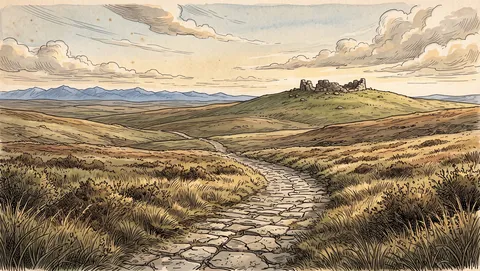
Angmar was a realm of the far North of Eriador, and the chronicles fix its place by its neighbours, not by any account of its own soil. It lay north of the Ettenmoors, the troll-haunted fells above Rivendell, so that this wild upland stood between it and the lands where the Dúnedain lived. Its territory did not stop at the Misty Mountains but reached across them, taking in ground on both the western and the eastern flank of the range. The sources give no line for its outer bounds to the north or east, and they give no measure of its extent. What they record is its position as seen from the south, a dark country at the head of the northern marches that looked down upon the divided North-kingdom.1
Its nearest neighbour among the successor kingdoms of Arnor was Rhudaur, the north-eastern realm between the Ettenmoors, the Weather Hills and the Mountains. Angmar pressed on Rhudaur first, and the two territories came to act almost as one hostile front against Arthedain and Cardolan further west. From there its power reached far beyond its own borders. The chronicles describe how, after the great sickness had emptied Cardolan, evil spirits out of Angmar and Rhudaur came to dwell in the old mounds of the Barrow-downs. The haunting of those downs, which the hobbits later passed through, is thus one of the longest-lasting marks the realm left on the land of Eriador.2
What set Angmar apart was less its landscape than its people. It was not an old kingdom of Men with a line of native kings but a gathering place, drawn together from many hostile sources. Wicked Men came there, together with Orcs and other cruel beings of the wild. Its chief stronghold was Carn Dûm, and the name of that fortress survived in the memory of the barrows: in the vision that comes to Merry on the downs, the men of Carn Dûm fall upon the defenders by night. Beyond this the texts describe no towns, roads or fields of Angmar. It appears in them only as a seat of war, a land defined by the enemies it sent south.3
- 1The Lord of the Rings, Appendix A, I (iii), Eriador, Arnor and the Heirs of Isildur
- 2The Lord of the Rings, Appendix A, I (iii), Eriador, Arnor and the Heirs of Isildur; The Lord of the Rings, Book I, ch. 8
- 3The Lord of the Rings, Appendix A, I (iii), Eriador, Arnor and the Heirs of Isildur; The Lord of the Rings, Book I, ch. 8
History
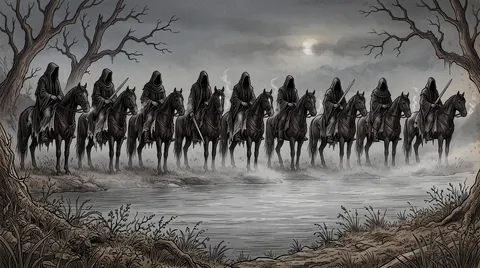
The chronicles of the North-kingdom set the coming of Angmar in the days of Malvegil of Arthedain, and the Tale of Years gives the date as about 1300 of the Third Age. At that time evil things were multiplying again in the North, Orcs were increasing in the Misty Mountains, and the Nazgûl had reappeared. The chief of the Nine went north and made Angmar his seat. Its master was known to the Dúnedain only by the realm he ruled. The North-kingdom had long since broken into Arthedain, Cardolan and Rhudaur, and the new power arose on the edge of that divided land.1
Angmar's first gains came through Rhudaur, not open conquest. Argeleb, son of Malvegil, claimed the lordship of all Arnor, since no heirs of Isildur remained in the other two kingdoms. Rhudaur resisted him. Few Dúnedain were left there, and rule had passed to a chieftain of the Hill-men who was bound in secret to Angmar. Argeleb fortified the Weather Hills against this alliance but fell in battle with Rhudaur and Angmar in 1356. His son Arveleg, aided by Cardolan and Lindon, drove the enemy back from the hills. For many years afterwards the Dúnedain held a frontier along the Weather Hills, the Great Road and the lower Hoarwell.2
In 1409 a great host came out of Angmar, crossed into Cardolan and closed round Weathertop. Arveleg fell in the fighting and his Dúnedain broke. The tower of Amon Sûl went up in flames and was razed to the ground, though the palantír was got out in time and taken to Fornost. Rhudaur was then occupied by evil Men subject to Angmar, and the Dúnedain who remained there were killed or fled west. Cardolan was laid waste, and a faithful remnant held out only on Tyrn Gorthad or in the forest behind it. Araphor, Arveleg's son, was still young but, with the help of Círdan, drove the enemy from Fornost and the North Downs. The chronicles add that for a time Angmar was held in check by Elves from Lindon and from Rivendell, for Elrond brought aid over the Mountains from Lórien.3
The last blow fell on Arthedain in 1974, when the power of Angmar rose again and the Witch-king came against the one surviving kingdom of the North. Arvedui, the last king, held the North Downs as long as he could, then fled northward, and Fornost was taken. The Witch-king made his dwelling in the royal city and filled it with his own evil people. Help had been sought from Gondor, but it came too late. Arvedui was lost the following year, drowned in the ice of the Bay of Forochel, and with him the kingship of Arthedain came to an end.4
In 1975 Eärnur of Gondor brought a fleet to Mithlond. Joined by Círdan's host from Lindon and what was left of the northern Dúnedain, he crossed the Lune and marched against the Witch-king. The Witch-king went out from Fornost to give battle and was defeated. As he retreated toward his own land, the horsemen of Gondor pressed him from behind, and Glorfindel came up with an army from Rivendell. The forces of Angmar were broken so completely that no Man or Orc of that realm was left west of the Mountains. Eärnur wished to ride after the fleeing king. Glorfindel restrained him, foretelling that the Witch-king would not fall by the hand of a man and that his end lay far in the future. The Witch-king then vanished from the North.5
Angmar did not rise again as a realm, but its lord's war went on elsewhere. In 1980 the Witch-king came to Mordor and gathered the Nazgûl there. The Nine besieged Minas Ithil from 2000 and took it in 2002, and the city became Minas Morgul, his seat for more than a thousand years. The old enmity of the North was settled only in March 3019, on the Pelennor Fields. There a blade forged by the Dúnedain of Arnor for their wars against Angmar helped to bring down the Witch-king. The weapon had been carried out of the barrows of the Dúnedain of Cardolan.6
- 1The Lord of the Rings, Appendix A, I (iii), Eriador, Arnor and the Heirs of Isildur; The Lord of the Rings, Appendix B, The Tale of Years
- 2The Lord of the Rings, Appendix A, I (iii), Eriador, Arnor and the Heirs of Isildur; The Lord of the Rings, Appendix B, The Tale of Years
- 3The Lord of the Rings, Appendix A, I (iii), Eriador, Arnor and the Heirs of Isildur; The Lord of the Rings, Appendix B, The Tale of Years
- 4The Lord of the Rings, Appendix A, I (iii), Eriador, Arnor and the Heirs of Isildur; The Lord of the Rings, Appendix B, The Tale of Years
- 5The Lord of the Rings, Appendix A, I (iv), Gondor and the Heirs of Anárion; The Lord of the Rings, Appendix B, The Tale of Years
- 6The Lord of the Rings, Appendix B, The Tale of Years; The Lord of the Rings, Book V, ch. 6
Peoples and Rule
The sources give Angmar no native people and no dynasty. What they describe is a population drawn in from outside, the hostile Men, Orcs and other creatures noted above, held together by the will of one master and not by kinship or long settlement. Over nearly seven centuries of recorded conflict, from the realm's rise to its overthrow at Fornost, the chronicles name no other ruler, heir or deputy. Angmar had one lord only, and he was known to his enemies by title alone. The Dúnedain did not learn until later that this lord was the chief of the Ringwraiths. He had come north to destroy the heirs of Elendil in Arnor, judging that their quarrels among themselves gave him an opening while Gondor in the south was too strong to attack.1
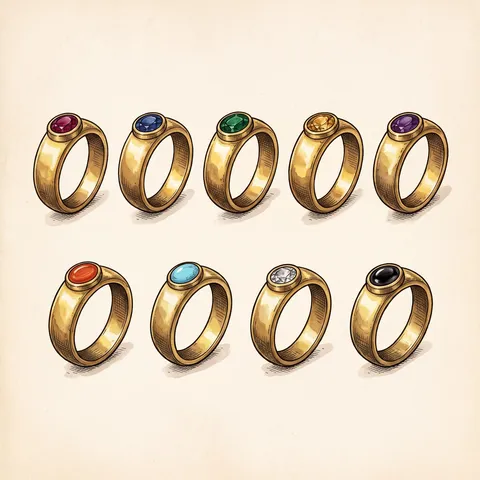
This makes Angmar's rule a form of servitude at one remove. The Ringwraiths had once been mortal Men who received the Nine Rings from Sauron and were slowly bound to his will until only shadows of themselves remained. The lord of Angmar therefore held his realm not in his own right but as the foremost servant of the Dark Lord. The kingdom he built served that larger purpose. It was an instrument of war raised against the North, not a state pursuing interests of its own.2
Angmar's dealings with its neighbours followed the same pattern. Where it could, it worked through others, and its one lasting partner was the Hill-men of Rhudaur, whose lordship had already passed out of Dúnedain hands. Everyone else around it was an enemy: the Dúnedain of all three northern kingdoms, the Elves of Lindon and Rivendell, and in the end Gondor as well. Even the hobbits of the Shire later claimed a small part in that enmity. By their own account they sent archers to fight for the king of Arthedain in the last battle against Angmar, though the records of Men make no mention of it.3
- 1The Lord of the Rings, Appendix A, I (iii), Eriador, Arnor and the Heirs of Isildur; The Lord of the Rings, Appendix B, The Tale of Years
- 2The Silmarillion, Of the Rings of Power and the Third Age; The Lord of the Rings, Book I, ch. 2, The Shadow of the Past
- 3The Lord of the Rings, Appendix A, I (iii), Eriador, Arnor and the Heirs of Isildur; The Lord of the Rings, Prologue, 1, Concerning Hobbits
In the Story
Angmar is never visited in The Lord of the Rings. No character travels there, and the main narrative never describes it directly. It enters the tale through the things it left behind. It is first named in the Barrow-downs, when Tom Bombadil gives the hobbits the blades from the mound. As he hands them over, he explains that they were made long ago by Men of Westernesse. Those Men opposed the Dark Lord and were overcome by the evil king of Carn Dûm in the land of Angmar. So the realm comes into the story as an old defeat, attached to weapons that the hobbits carry south without knowing what they will be used for.1
Later chapters connect that remote name to the enemy the travellers actually face. In Minas Tirith, Gandalf names the captain of the host from Morgul as the lord who once ruled Angmar. The reader learns that the leader of the Black Riders and the sorcerer-king of the northern wars are the same being. The payoff comes on the Pelennor. The narrator stops at the moment Merry strikes and looks back to the North-kingdom. The blade was forged there, in the years when Angmar was the chief enemy of the Dúnedain, and its making was aimed at exactly this foe. Only such a weapon, the text suggests, could have wounded him so deeply.2
Within the book, then, Angmar works less as a setting than as a debt that remains unpaid for a long time. It stands for the ruin of the North and for the long defeat of the Dúnedain. It also stands for the idea that a purpose set in motion ages earlier can still reach its end. The appendices add the counterpart to this pattern. After the Witch-king's rout in the North, Glorfindel foresees that he will not fall by the hand of a man. The Pelennor fulfils that foresight through a woman and a hobbit. The weapon is a blade from Arnor, and in this way the war that began in Angmar is finished in the South.3
- 1The Lord of the Rings, Book I, ch. 8
- 2The Lord of the Rings, Book V, ch. 4, The Siege of Gondor; The Lord of the Rings, Book V, ch. 6, The Battle of the Pelennor Fields
- 3The Lord of the Rings, Appendix A, I (iv), Gondor and the Heirs of Anárion; The Lord of the Rings, Book V, ch. 6, The Battle of the Pelennor Fields
Adaptations
No adaptation shows Angmar as a place. It has no setting of its own on screen, and because it is a realm and not a character, no actor or speaker is attached to it. In Peter Jackson's trilogy the name survives mainly in the Witch-king's title. In the third film Gandalf uses it when he identifies the captain of Sauron's host as the chief of the Nine and the rider who wounded Frodo at Weathertop. The link the novel builds through the barrow-blades is largely lost. The films leave out Tom Bombadil and the Barrow-downs, and the hobbits receive their short swords from Aragorn on the way to Weathertop, so the blades have no stated origin in the old wars of Arnor. Merry's stroke on the Pelennor keeps its place in the story. What the films drop is the explanation that the weapon was made in the North for use against this particular enemy.1
The later Hobbit trilogy draws on the Witch-king's northern past to support its own expanded plot, and in doing so it adds material that has no basis in Tolkien. The films invent tombs for the Nine in the High Fells of Rhudaur, where the Ringwraiths are said to have been sealed after their defeat, and the White Council takes a Morgul blade found there as a sign that the enemy is stirring again. Tolkien's appendices say nothing of any burial or imprisonment of the Nazgûl. After the rout of Angmar they record only that its lord vanished from the North and later gathered the Nine in Mordor. In these films Angmar again appears only through the Witch-king's title and through its neighbour Rhudaur, never as a realm shown on screen.2